Loading case study…
Creating The Category That Builds The Room - A GTM Roadmap for Pulsara

Bonnie TaylorNovember 23, 2026
Fractional Marketing Consultant
Views (2)
Show summary
- RPM demand is structural, with hospitals dominant; Pulsara has $40 million, 18–24 months runway, design partners, but no repeatable sales motion.
- Pulsara needed a fundable 1–3-year GTM roadmap, avoiding premature expansion while proving pilots convert and producing CFO-credible clinical and financial outcomes.
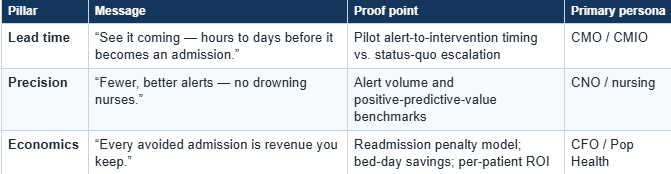
- The strategy focused on predictive heart-failure deterioration for mid-sized regional systems, differentiating through measurable alert precision, intervention lead time, and readmission reduction.
- A 90-day, $75,000–$100,000 pilot enrolled 150–300 patients, tested detection and workflow, measured readmissions, and required predefined conversion and CFO ROI criteria.
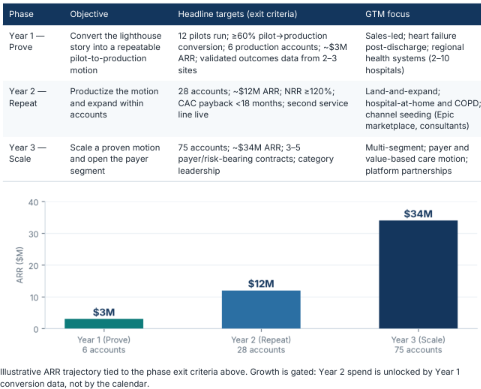
- The board approved the roadmap, targeting sequenced growth from $3 million ARR to $34 million over three years with evidence-led expansion.
The context
The remote patient monitoring (henceforth referred to as RPM) market is projected to grow from $36.29B in 2026 to $66.33B by 2031, a 12.8% CAGR. Hospitals and health systems are the dominant buyer — roughly 59% of software revenue in 2025 — and North America leads adoption with over 40% of the global market. The U.S. market alone is estimated at $19B in 2026. Demand is structural, not cyclical. Chronic disease prevalence, nursing shortages, readmission penalties, value-based care risk, and hospital-at-home programs all push care teams to monitor more patients with fewer clinicians.
Pulsara, a fictional healthtech company, has raised a Series B round of funding of approximately $40M with 18-24 months of runway. The remote monitoring platform focuses on flagging at-risk patients before escalation. It combines a device-agnostic biosensor data layer with a predictive engine that flags patient deterioration early, delivered through clinical workflow software that integrates with the EHR. Today, the company has a handful of design partners, no repeatable sales motion, and one clinical service line in production.
Provider intent is strong and rising: a Vivalink survey found 84% of providers already using RPM plan to increase usage. Meanwhile, the deterioration-detection category specifically is being pulled forward by the CMS Acute Hospital Care at Home waiver program, which requires continuous monitoring of acute patients at home.
The challenge
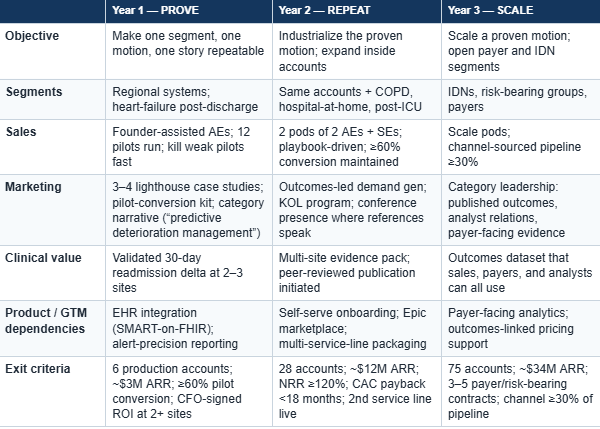
Pulsara's board engaged me as a fractional product marketing consultant to create a 1-3 year GTM roadmap it can fund. More specifically, they want a roadmap to fund a focused GTM organization (~12 people across sales, marketing, clinical value, and customer success) and the pilot infrastructure in Year 1. There is no bet on Year 3 here - what I have been asked is to fund the evidence that makes Year 3 credible.
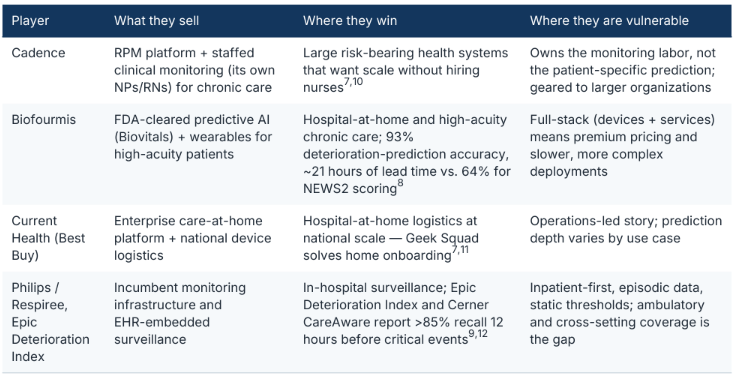
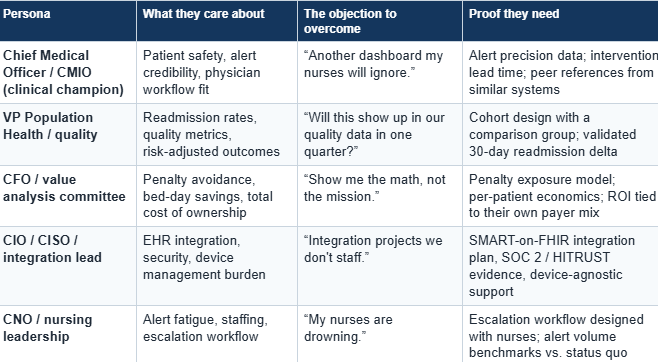
There are three ways this plan can fail - breadth before proof, pilots that never convert, and stories without numbers. Instead of chasing multiple segments, service lines, and buyer types at once, we pick one lane and stick to it. We design the pilot motions around conversion, not logos, and ensure the budget owner sees the savings. And, last but not least, we ensure the CFO math that packs the punch behind the clinical messaging makes it through committee.
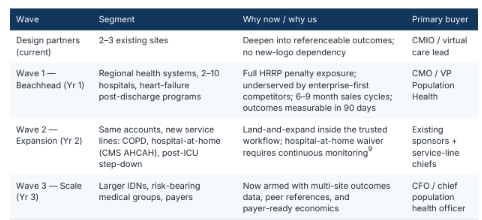
The strategic risk at Series A/B is not competition; it is un-sequenced expansion. Health systems buy slowly, demand clinical proof, and churn quietly when pilots produce alerts instead of outcomes. The roadmap therefore sequences segments, motions, and milestones so each phase de-risks the next: Year 1 proves the story, Year 2 industrializes it, Year 3 scales it.
The approach
The tools
The result
Pulsara's board approved my GTM roadmap, which lays out a clear vision for the next three years. Achievable milestones, sequences with reasonable goals, and a clear path from $3 million ARR to $34 million within the next three years paint a bright future for a company dedicated to saving lives.
Like this approach?
Discover how this approach could help you reach your professional goals.
or share this case study with your network
Author
Bonnie TaylorNovember 23, 2026
Fractional Marketing Consultant
Views (2)
Discover more on Dusted

Donna Cantrill11h ago
Product Marketing Manager in Education
Education
One Story, Every Rep: Fixing SKILLFRAME's Sales Message
Donna set out to unify SKILLFRAME’s sales message and help reps overcome LMS-related objections. They interviewed stakeholders, reviewed sales and marketing materials, used AI to build a Clarity Framework, and created pe Read more
0
Views (4)


Comments
No comments yet. Be the first to share what you think.