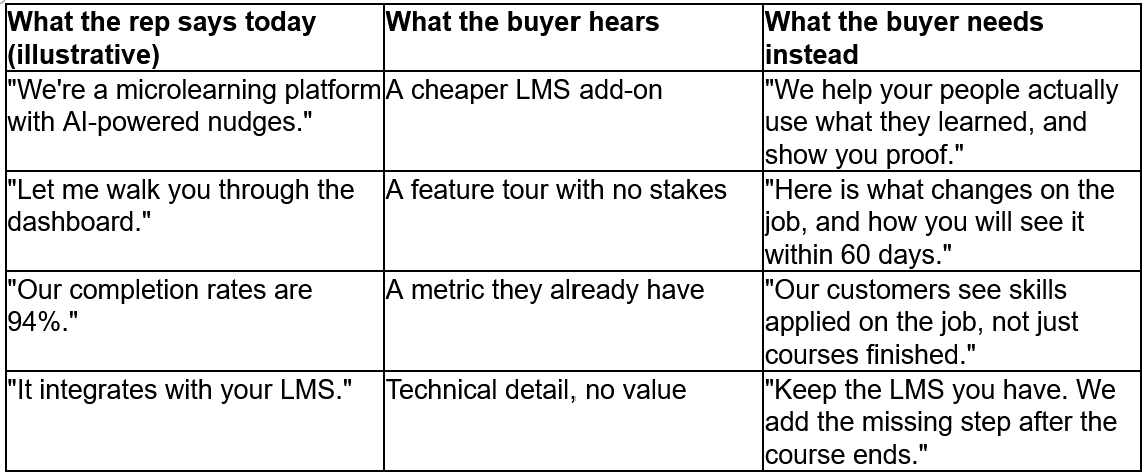
The underlying PMM skill the problem calls for is sales enablement and message simplification. To reiterate, my job as the PMM in this fictional scenario is to quickly equip the Sales team with the tools to help them tell the right story to the right persona, so they can win more deals.
As a PMM, I like to ask myself the following questions to get clarity:
- Who is this actually most valuable for?
- What do they care about most?
- What are they comparing us against?
- Which part of the feature matters enough to talk about?
- What does sales need to explain it confidently?
- What should we leave out because it adds complexity without adding value?
- What should we NOT say in our story to avoid confusion?
- What is the story worth telling?
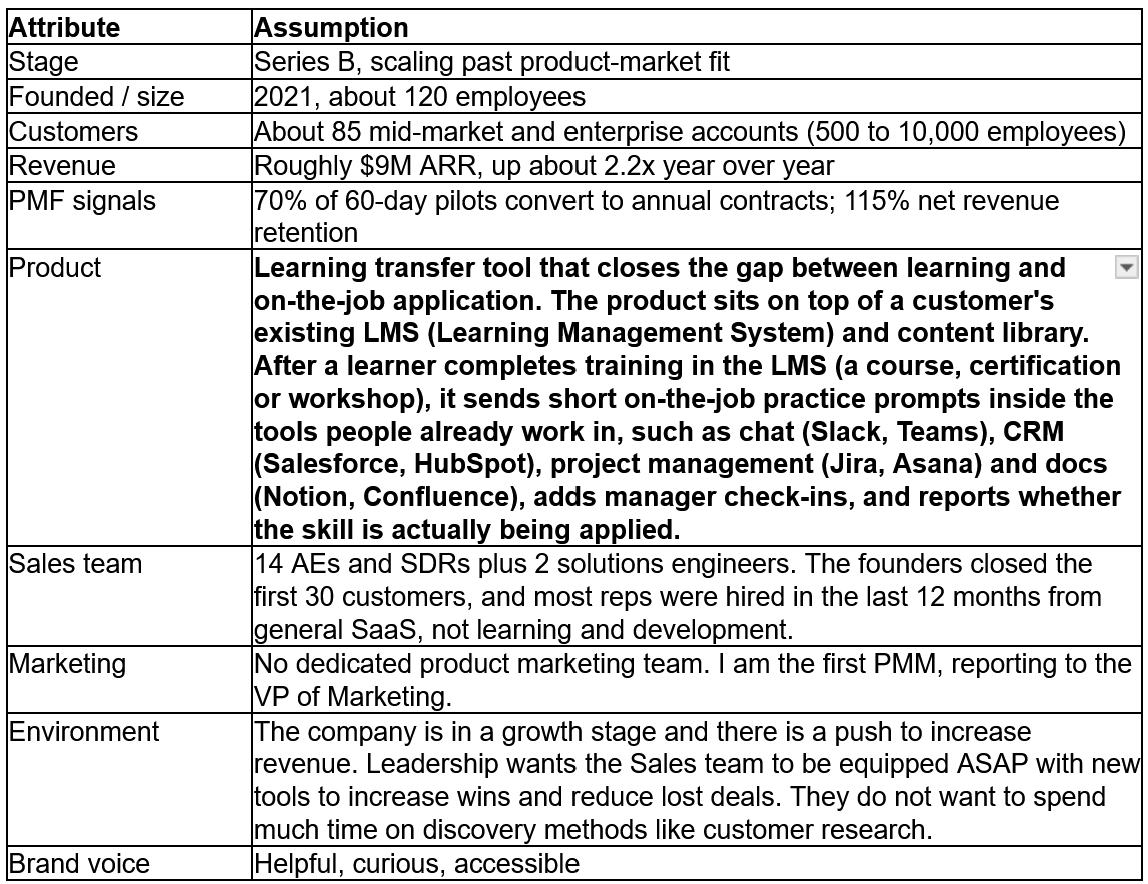
As there is no source of truth and to help answer the above questions, the first step was to put together a Clarity Framework document as the foundation for all GTM assets (including sales enablement) to be built upon. This is a template I took from ‘clarity king’, Zach Messler, in the first PMM Jam I joined which I found so helpful and decided to use again. I believe having a strong and solid Clarity Framework that is accessible for all teams helps to make sure everyone in the company is on the same page, therefore messaging is consistent internally and externally.
If this was a real scenario, I would put together the Clarity Framework by giving myself one week to interview the founders and also key stakeholders from Sales and Product. I would then provide the below to a LLM to synthesize and populate the Clarity Framework, then validate this with the founders and key stakeholders:
- Discovery interviews with founders and key stakeholders from Sales and Product
- Sales calls from the last 3 months to see where we were losing deals and why, and capture recurring objections and moments of confusion
- Website
- Blog posts
- Social media channels
- White papers
- Brochures
- Proposals
- Sales pitch decks
- Battlecards
- Any other internal and external marketing collateral that touches the customers
Next, to equip the Sales team with tools they can start using straightaway, the following sales enablement assets were created using the Clarity Framework as a base:
- Pitch Package:
- Snapshot overview of the product (also taken from Zach Messler)
- Personas
- 30-Second Story for each persona
- Sales Talk Tracks for each persona
Alternatives considered:
Ideally, I would put together a core messaging document using a Messaging Framework (PMA template) first before any sales enablement materials were created, to go more in-depth about the product and customers, so that messaging can be even more clear and compelling. This would require some upfront discovery work and analysis (~1 month) by performing the below:
- Discovery
- Conducting discovery interviews with other key stakeholders from Customer Success, Support and Technology
- Conducting/sitting in on 20+ sales and customer calls (prospects and existing customers)
- If I’m unable to join, I would use AI to pull transcripts to get themes and customer quotes to build a better picture of the buyers and users and to gather proof points.
- Analysis
- Reviewing support escalations from the past 3-6 months
- Website teardown
- Reviewing existing marketing collateral: Email campaigns, blog posts, brochures, etc.
- Reviewing Win/loss notes
- Reviewing Implementation debriefs
- Gathering proof points
- Testimonials, case studies, awards
As leadership wants sales reps to be equipped ASAP with tools, the Messaging Framework and associated activities can be actioned later if the business and time allows.
I decided to not pursue other sales enablement materials like battlecards, as it was important for the sales reps to nail the story first and how to explain the product to the customer depending on the persona.
Case Study scope tradeoff: Given the scope of this Case Study, I built the Pitch Package to full depth for Sarah, the primary buyer, and Marcus, the internal champion and often the first contact. For Dana and Sam, I built lighter persona cards: a persona table, a 30-second story, two discovery questions and two objections with responses. This was a deliberate tradeoff. Sarah and Marcus are the personas reps meet first, so they get the most polish, and in a real scenario I would deepen the Dana and Sam cards after testing with sales reps.




Comments
No comments yet. Be the first to share what you think.