Loading case study…
Strategy & Transformation Advisor in Technology & Software
Customer success stories are valuable. But what about the market intelligence hiding inside them?
Throughout the customer lifecycle, B2B SaaS companies uncover insights that can challenge how they think about their products and markets. Customers discover unexpected uses, adapt products to new workflows, and report outcomes that weren't necessarily part of the original buying rationale.
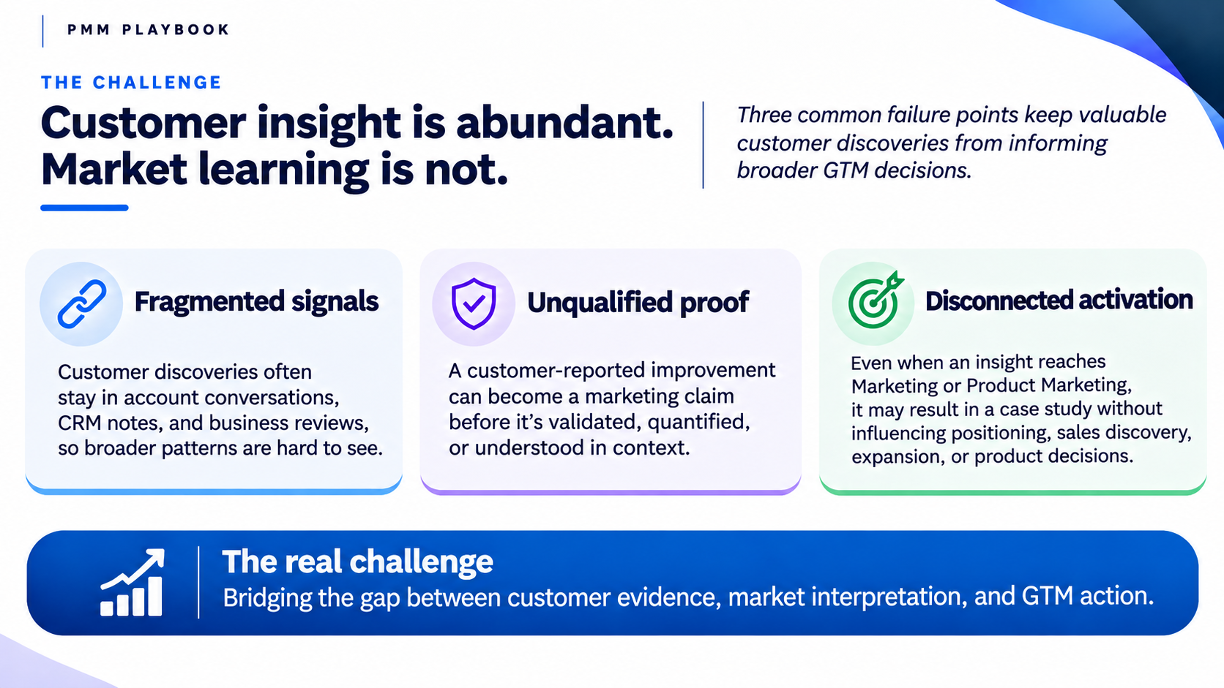
Customer insight is abundant. Market learning is not.
The problem I wanted to solve wasn't simply how to capture more customer stories. It was how to ensure meaningful customer discoveries could influence the decisions a business makes about its market. I identified three interconnected failure points:
1. Fragmented signals
Customer Success teams hear about unexpected use cases, workarounds, emerging needs, and outcomes. But those discoveries can remain buried in account conversations, CRM notes, and business reviews, making broader patterns difficult to recognize.
I designed a customer insight decision engine to translate real-world customer discoveries into evidence-qualified market insights and actionable GTM decisions.
Discover how this approach could help you reach your professional goals.
or share this case study with your network
Strategy & Transformation Advisor in Technology & Software
Fractional Marketing Consultant
Bonnie developed a three-year GTM roadmap for Pulsara, focusing on heart-failure deterioration prediction among regional health systems. They designed conversion-focused pilots, evidence-based milestones, and staged team Read more
These discoveries often surface through Customer Success conversations, business reviews, and account relationships. They can reveal not just whether customers are getting value, but how they're creating it, what problems they're really solving, and who else might benefit.
Yet much of this learning stays within individual accounts or becomes a single-purpose customer story.
I saw an opportunity to connect two disciplines that are often managed separately: customer value realization and product marketing.
What if customer evidence could become a more systematic input into positioning, messaging, sales discovery, product decisions, and growth opportunities?
That question became the starting point for the Customer Evidence-to-Market Activation Playbook, a PMM-led methodology designed to turn customer discoveries into credible, actionable market intelligence.
This is a concept-development project created for the PMM Jam Fall 2026 Sprint. The methodology is illustrated using a fictional B2B SaaS company and has not yet been implemented.
2. Unqualified proof
A customer-reported improvement can become a marketing claim before anyone has established what actually happened, what contributed to the outcome, or whether the experience is repeatable.
3. Disconnected activation
Even when an insight reaches Marketing or Product Marketing, it may result in a testimonial or case study without informing broader decisions about buyer personas, positioning, sales discovery, customer expansion, or product direction.
The underlying challenge is a missing connection between customer evidence, market interpretation, and GTM action.
A traditional customer story repository can help organize content, but it doesn't necessarily answer the more strategic questions: What does this discovery mean for our market? How strong is the evidence? And what should we do differently because of it?
My design challenge:
How might Product Marketing turn customer discoveries into evidence-qualified GTM decisions, without introducing another burdensome process?
The solution needed to be lightweight, cross-functional, and practical enough to fit into existing workflows. Most importantly, it needed to help teams distinguish between what they know, what they think, and what they need to learn next.

The goal was to create a practical way to interpret what customer discoveries reveal about the market and determine what an organization can credibly do with them. I developed the Customer Evidence-to-Market Activation Playbook around three design principles.
1. Interpret customer evidence as GTM signals
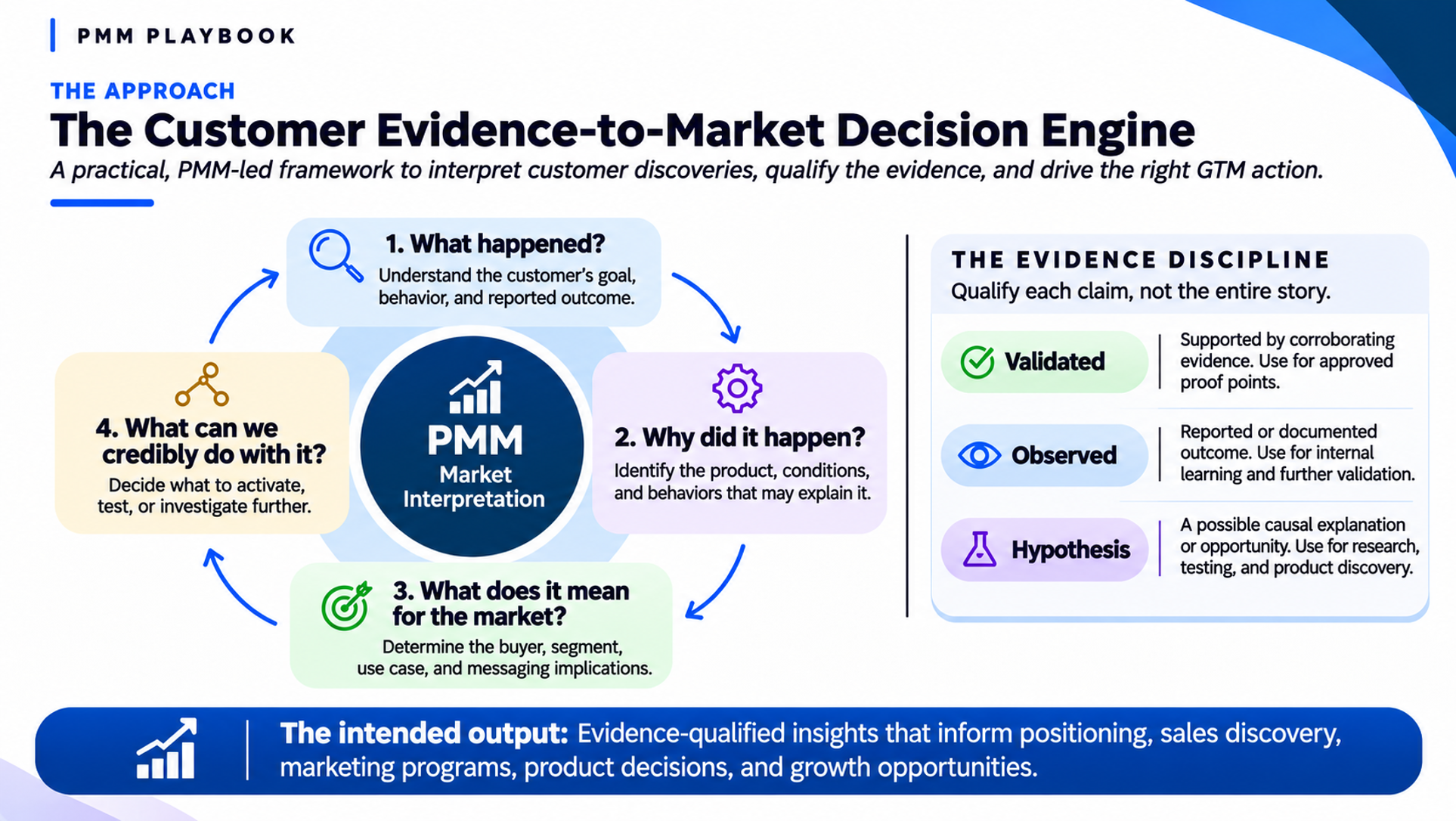
I positioned Product Marketing as the bridge between customer discovery and market strategy, using four questions to guide interpretation:
The shift: From “Can we turn this into a customer story?” to “What should we learn or do differently because of this discovery?”
2. Qualify the evidence before amplifying the story
Not every customer-reported outcome is a validated market claim. I introduced three evidence classifications: Validated, Observed, and Hypothesis, applied to individual claims rather than entire customer stories. For example, a customer reporting fewer repeated questions after adopting a new workflow is useful evidence, but it doesn't establish a quantified productivity improvement or prove causation. This distinction allows teams to learn from early signals without overstating what the evidence supports.
3. Build on existing workflows, not another governance layer
The operating model follows five connected stages:
Surface → Interpret → Decide → Activate → Learn
Customer-facing teams surface meaningful discoveries. PMM evaluates the evidence, interprets market implications, and recommends a course of action. Marketing, Sales, Customer Success, and Product activate relevant insights through existing workflows, then feed learnings back into the process. Not every discovery warrants a campaign, case study, or product initiative. The goal is a repeatable decision-making capability, not more activity.
The resulting framework brings these principles together: four questions to guide interpretation, an evidence discipline to protect credibility, and a practical path from customer discovery to GTM action.

From customer discovery to GTM action: Making the methodology operational.
A framework only creates value if people can use it. I translated the Customer Evidence-to-Market methodology into a set of lightweight, connected tools designed to fit into existing cross-functional workflows. Rather than introducing another system, each tool serves a distinct purpose: capture the signal, qualify the evidence, and direct the next action.
1. Customer Evidence Intake & Triage Template | Capture
I created a reusable, one-page working template that enables Customer Success to surface meaningful discoveries without requiring a lengthy business case or formal customer story. The template separates two responsibilities:
The intended output is a clear decision with an accountable owner, not another entry in a content repository.
2. Customer Evidence Activation Canvas | Interpret and decide
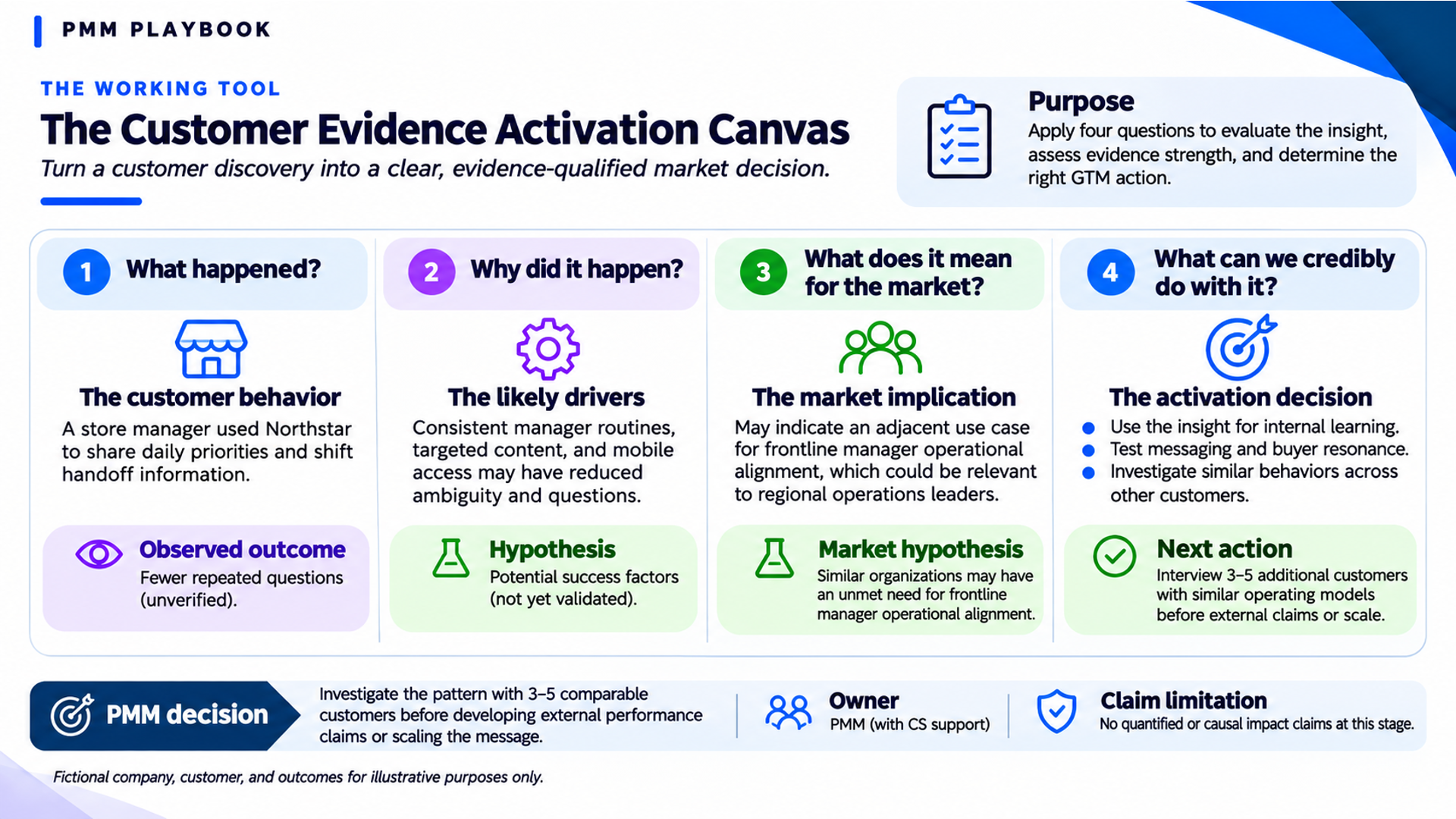
The Activation Canvas applies the four-question decision engine to a specific customer discovery. To illustrate its application, I developed a fictional example featuring Northstar, a B2B employee communications platform. A multi-location retailer originally purchased Northstar to distribute company announcements. During a customer check-in, a store manager revealed that they were also using the platform to coordinate daily priorities and shift handoffs, reporting fewer repeated questions. That discovery raised a potentially valuable question: Could frontline manager operational alignment represent an adjacent use case and buyer opportunity? The Canvas distinguishes what is known from what remains hypothetical:
PMM decision: Investigate the pattern with 3–5 comparable customers before developing external performance claims or scaling the message.
This is the critical distinction: the insight informs a market hypothesis, not an automatically approved marketing claim.

3. Slack workflow prototype | Connect and activate
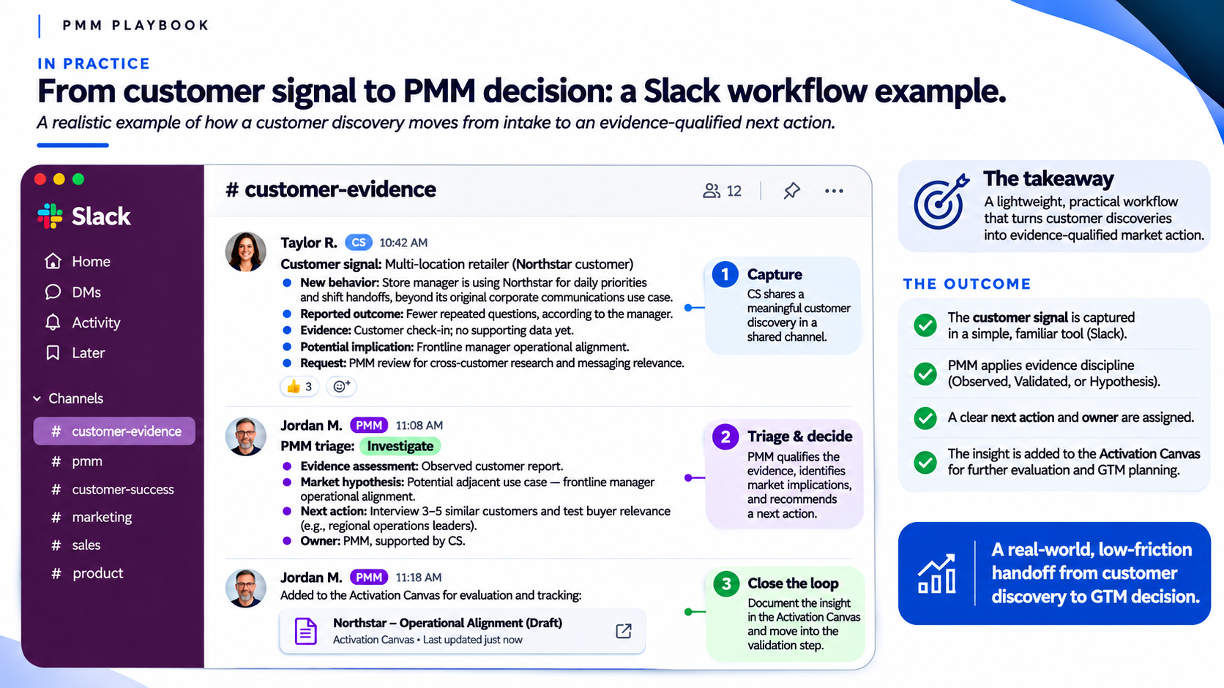
I also designed a fictional Slack-based workflow to demonstrate how the process could operate within tools teams already use. A Customer Success manager submits a discovery through a shared channel. PMM reviews the signal, identifies the evidence limitations, and assigns the next action. The team can then connect the finding to the Activation Canvas and route relevant learning to Sales, Marketing, Product, or Customer Success. The mockup illustrates the intended handoff and accountability model. It is not a deployed Slack integration.

4. Customer Evidence-to-Market Activation Playbook | Scale
Finally, I brought the methodology together in an eight-slide PMM playbook covering the problem, decision engine, evidence discipline, cross-functional operating model, populated example, potential GTM applications, and an illustrative 90-day activation plan. The playbook provides a starting point for teams to pilot the capability, adapt it to their operating model, and establish a feedback loop between customer learning and market decisions.
Together, these tools create a practical progression:
Customer signal → PMM triage → Evidence-qualified interpretation → GTM decision → Test and learn
The objective is not to generate more customer content. It's to help organizations make better market decisions with the customer evidence they already have.
Explore the Playbook & Tools
The complete Customer Evidence-to-Market Activation Playbook brings together the decision framework, cross-functional operating model, illustrative customer scenario, six potential GTM applications, and a practical 90-day activation approach.
The companion Customer Evidence Intake & Triage Template provides a lightweight, reusable way for customer-facing teams to capture meaningful signals and for PMM to qualify evidence, assess market implications, and determine the next action.
The outcome: A practical PMM capability, ready to pilot.
The result of this project is a reusable, PMM-led methodology that connects customer evidence to market interpretation and actionable GTM decisions. Rather than creating another customer story repository, I developed a connected set of assets that teams can adapt to their existing operating models:
What makes this different
The methodology is designed to move beyond documenting customer success toward systematically learning from it. A single discovery can inform multiple market applications, including positioning and messaging, sales discovery, customer expansion, use-case development, and product direction. But those applications are not automatic. The evidence must support the action.
What success would look like
Because this is a concept-development project, the methodology has not yet been deployed or measured. The next step would be a focused pilot to evaluate:
The illustrative 90-day pilot would establish baseline measures, test the operating rhythm, and identify where the methodology creates enough value to scale.
The broader opportunity
The value of customer evidence shouldn't end with proving that an individual customer succeeded. When Product Marketing systematically interprets what customers are doing, why it matters, and where the evidence points next, customer learning can become an ongoing input to market strategy.
The intended outcome: Better market decisions, stronger claims, and more coordinated GTM action, grounded in real customer experience.
Product Marketing Manager in Education
Donna set out to unify SKILLFRAME’s sales message and help reps overcome LMS-related objections. They interviewed stakeholders, reviewed sales and marketing materials, used AI to build a Clarity Framework, and created pe Read more
Product Marketing Manager in Technology & Software
Emmanuella set out to build PATCHWORK’s three-year go-to-market roadmap and investment case, combining segment analysis, positioning, pricing, financial modeling, and evidence-based funding gates to validate repeatable g Read more
Comments
No comments yet. Be the first to share what you think.