Loading case study…
From Product Silos to One Enterprise Platform Narrative

Elle GrossenbacherOctober 30, 2026
Founder at Dusted
Views (28)
Show summary
- Cisco’s expanding technology ecosystem created a complicated customer story, so wireless marketing needed to fit clearly within a unified enterprise platform narrative.
- The challenge was aligning many product stakeholders around wireless value while supporting cloud-platform adoption and enterprise platform deals across diverse customer segments.
- I organized messaging around shared customer outcomes, then created executive and practitioner layers so CIOs could grasp value while technical buyers retained depth.
- Customer data and an internal ChatGPT tool revealed persona priorities, while sales decks, Gartner Symposium, and LinkedIn Live translated insights into consistent market execution.
- Roadshow events sold out across every major U.S. city, while analysts, CIOs, sales teams, and field marketing validated and adopted the narrative.
The context
Cisco had grown into a broad ecosystem of technologies and management platforms through years of acquisitions and portfolio expansion. I was the product marketing lead supporting Cisco’s wireless portfolio, working in a market where enterprise IT decision-makers were evaluating not only individual network capabilities but also how easily those technologies could be managed together.
The immediate shift came as Cisco introduced a more unified platform approach: bringing multiple technologies into a single management experience and positioning them as one integrated solution rather than a collection of disconnected systems. Market and analyst feedback made the problem clear—the Cisco story had become too complicated, and customers were struggling to see how the pieces fit together. A global, multichannel campaign, including Cisco Live events and LinkedIn Live discussions, created the opportunity to simplify that narrative. My job was to make wireless capabilities, differentiators, and customer value visible within the larger platform story without competing with its central message.
The challenge
Cisco’s business objective was to increase adoption of Cisco Networking’s cloud platform and create more platform deals across enterprise segments. My objective was narrower but demanding: I owned messaging, content, launch execution, and stakeholder alignment for the entire Cisco Wireless portfolio—a business worth roughly $4B—and had to make its story fit inside the broader platform narrative while ensuring the platform story fully represented wireless value.
The main constraint was organizational complexity. Cisco had a large number of products, features, and internal stakeholders, each with priorities to protect. I needed to get everyone telling a consistent story, keep wireless portfolio leaders satisfied, and put the resulting narrative in front of the right enterprise audiences. Success would be measured by progress toward enterprise adoption of the cloud platform, including an increase in platform deals across segments—not simply by campaign awareness.
The approach
I made the strategic choice to organize the platform story around customer outcomes rather than letting each portfolio lead with its own technical features. Enterprise CIOs and other C-level buyers cared about business outcomes, while practitioners needed the technical depth to evaluate and operate the solution. The answer was not to choose one audience over the other, but to build a narrative that worked at both levels.
I started by aligning with my wireless portfolio stakeholders on the portfolio narrative and the value we needed to protect. I then worked with peers across Networking and with the tiger team responsible for the overall story. Together, we created a master persona document covering the enterprise IT audiences we needed to reach. We mapped each portfolio’s messaging to the priorities shared across those personas and identified common pillars that could support a cohesive “single pane of glass” narrative.
The main risk was that portfolio leaders would feel the outcome-based story was not technical enough. I addressed that by creating a content plan with two layers: an executive narrative focused on business outcomes and a practitioner-level story that went deeper into technical planning and decision-making. We used channels accordingly, including LinkedIn Live for the CIO-facing platform story, while keeping the technical detail available one click deeper.
The tools
I used our customer database and an internal, white-label version of ChatGPT to ground the narrative in customer evidence. We pulled together thousands of data points and used the AI tool to analyze what mattered to our C-level and practitioner personas. That gave me a faster way to identify patterns across the research and shape a story around the outcomes each audience cared about, rather than relying only on internal assumptions.
Once the narrative was established, I translated it into customer-facing slide decks for salespeople to use in enterprise conversations. We then carried the same message into various channels from C-level events, such as Gartner Symposium, to more public forums like LinkedIn Live. This gave us the right channels for telling the platform story directly to a CIO and C-level audience in person and virtually.
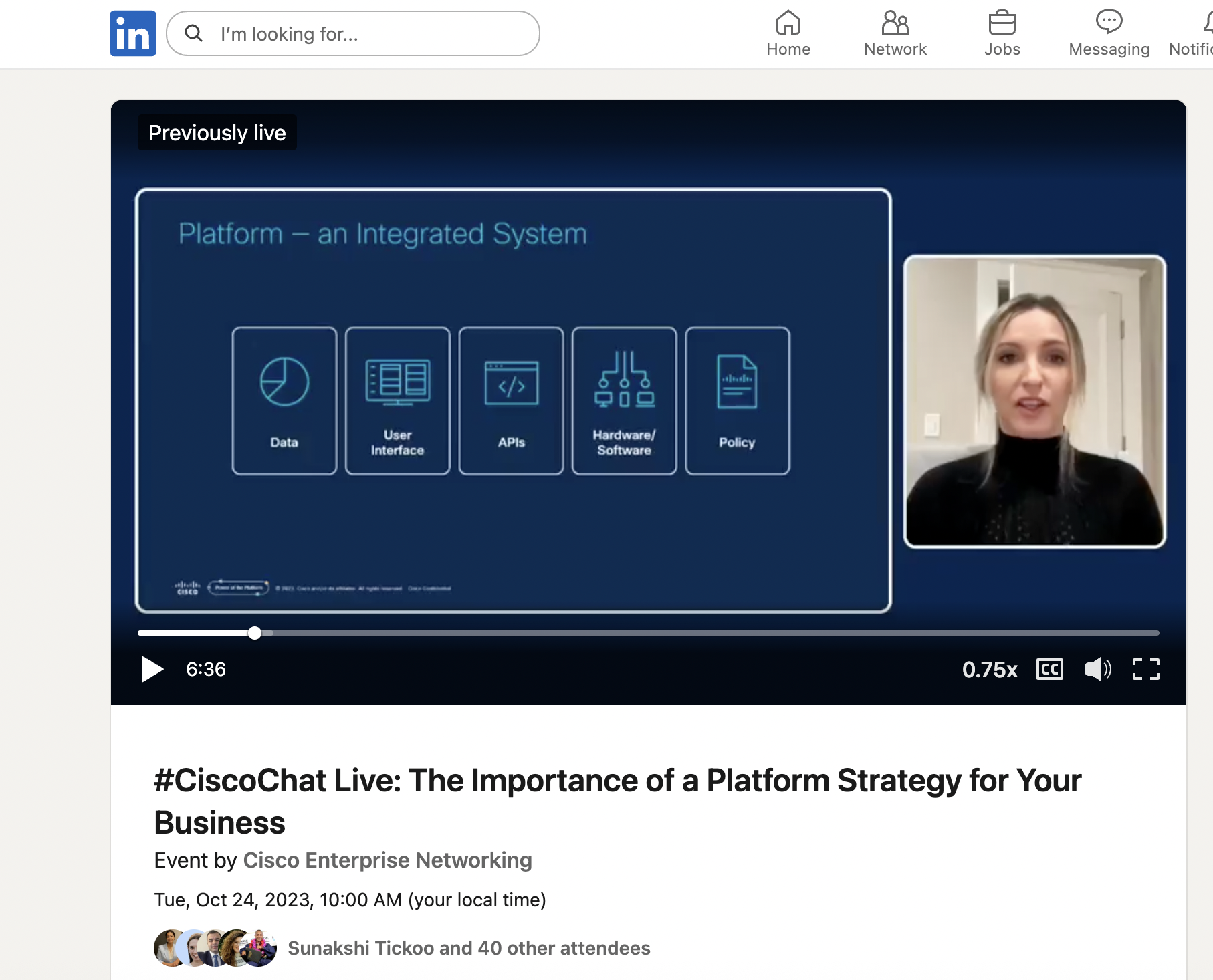
The best part of the toolset was how it connected insight to execution: customer data informed the narrative, the decks made it usable by sales, and LinkedIn Live extended it to the market. The AI accelerated synthesis, but the messaging judgment remained with me and the stakeholder group.
The result
The clearest result was market validation: every major U.S. city where the field marketing team took the platform story on the road was a sellout. The demand was a strong signal that the story resonated. We also received positive feedback in private discussions with analysts from Gartner, IDC, and Forrester, as well as CIOs from major enterprises on Cisco’s customer advisory board. Sales teams began using the narrative in enterprise conversations, and field marketing adopted it for the roadshow rather than treating it as a one-off campaign. The broader change was organizational: a story developed across portfolios became usable by sales and compelling to both CIOs and practitioners. The lesson was that simplifying a complex portfolio does not mean removing technical depth; it means sequencing the story around the outcomes senior buyers care about.
Like this approach?
Discover how this approach could help you reach your professional goals.
or share this case study with your network
Author
Elle GrossenbacherOctober 30, 2026
Founder at Dusted
Views (28)
Discover more on Dusted

Matthew AgnewOct 27, 2026
Senior Manager, Product Marketing at SOTI
Technology & Software
Building The Product Marketing Function From The Ground Up
Matthew set out to build a proactive product marketing function in an underserved SaaS company. He mapped stakeholder needs, built trust, centralized planning, introduced AI reviews, and used results to prioritize work a Read more
1
Views (46)


Comments
No comments yet. Be the first to share what you think.