Context: Corvane sold automation lines through capital budgets, bundling software, while a CFO push for recurring revenue exposed unclear annual value across buyer groups.
Challenge: Software sat behind hardware in sales materials, leaving customers unable to explain recurring value and reps without a consistent story beyond operating equipment.
Approach: Built positioning around Know, See and Direct, mapped products to buyer tasks, tailored messages by account situation, and pressure-tested claims through blind role-play.
Tools: Claude accelerated drafting, while four blind sub-agents tested operations, IT, compliance, CFO and rep perspectives; feedback exposed unsupported claims, not customer evidence.
Result: Delivered a reusable positioning framework and playbook with customer pickers, discovery prompts, objection flashcards and bundle guidance, giving reps consistent software conversations.
The context
What exactly are we paying for every year?
The challenge
What is happening. Corvane's software portfolio had outgrown its hardware-led sales story. Reps could explain the equipment, but had no consistent way to say what the software contributed beyond running it. Sales materials led with the processing lines and mentioned software last. Prospects watched robotics on site tours rather than a software demo. Customers could not say what they paid for each year. Those who own Analytics use it for retrospective reporting and feel the answers arrive too late, and they export the data by hand into other business systems. At least one pays for Analytics without using it as intended, and other customers have been hard to bring on at all. The evidence is rep feedback and a review of sales materials. The patterns are observed, not measured.
The approach
The tools
I used four kinds of tools, each for a different part of the work.
Claude Chat and Cowork helped me draft and restructure the case study and the positioning asset. Claude also proposed the Know, See, Direct frame. I kept it because the three questions map to the buying committee's existing concerns, not because an AI-generated framework sounded polished. The useful part was speed: I could generate several structures, then spend my time deciding which ones were true and usable.
Sub-agents gave me blind reactions to the asset from four perspectives: an operations director, IT and compliance, a lab CFO, and a rep taking three calls. I used their feedback to find unsupported claims, missing answers, and language that worked internally but would sound wrong in front of a customer. Their limitation was important: role-play produced hypotheses, not customer evidence. I treated the findings as prompts for revision and validation, not proof.
The result
The immediate result was a reusable positioning framework and playbook format for making a complex software portfolio easier to explain, sell and test. I turned the Linesight story into a consistent core claim, a three-part product structure, customer-specific openings, discovery questions, objection flashcards, bundle guidance and plain-language answers for IT, compliance and finance.
The practical change is that a rep no longer has to lead with six product names or improvise the software's contribution. I gave the reps a way to choose the customer's situation, open with the relevant task, bring the right proof and identify which questions still need a verified Corvane answer.
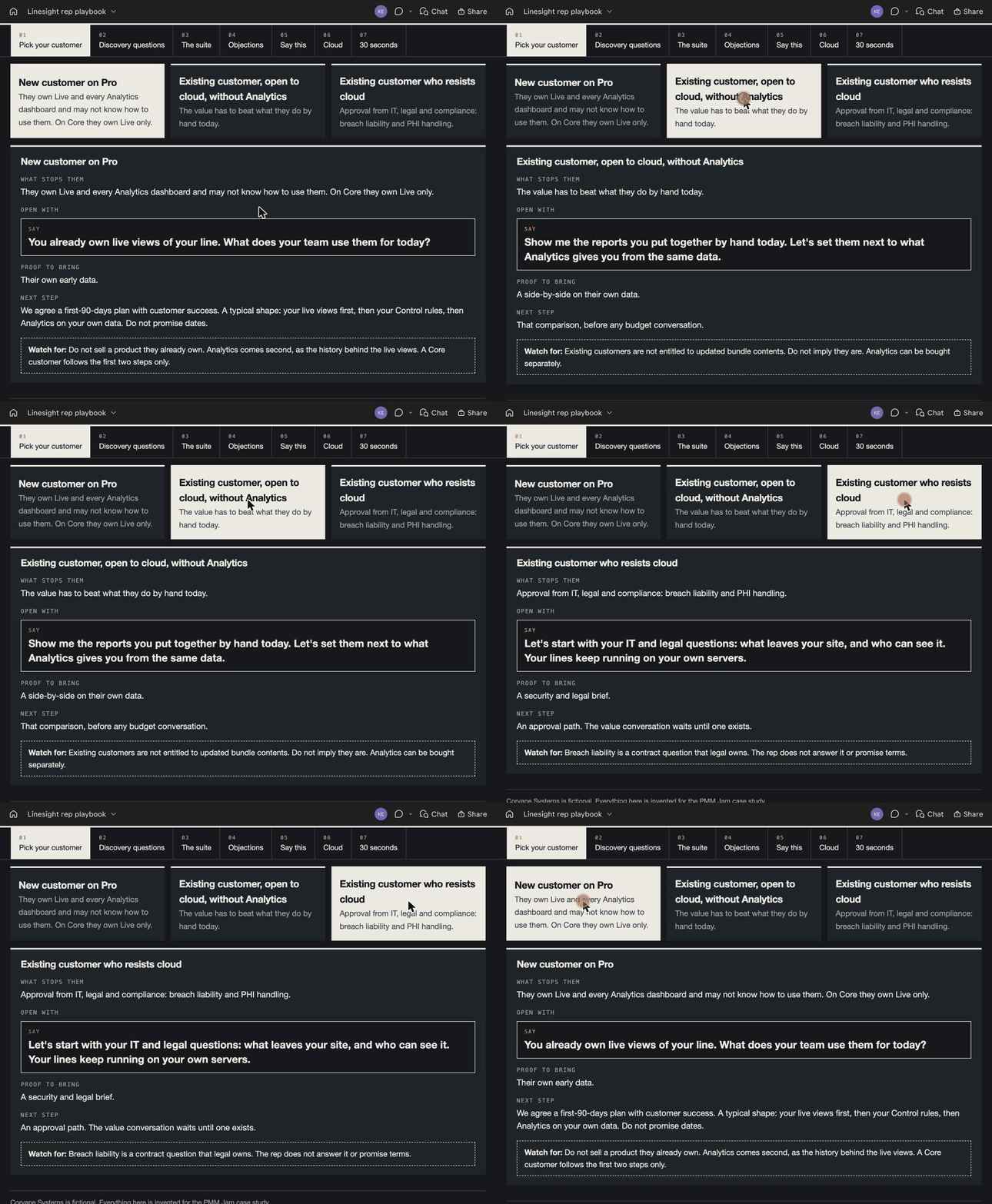
Customer Picker: This helps a seller choose a relevant starting point instead of presenting the whole portfolio.
Like this approach?
Discover how this approach could help you reach your professional goals.
Bonnie developed a three-year GTM roadmap for Pulsara, focusing on heart-failure deterioration prediction among regional health systems. They designed conversion-focused pilots, evidence-based milestones, and staged team Read more
Corvane is a fictional laboratory automation company selling specimen-processing lines to hospital and reference labs. I was responsible for developing and pressure-testing a positioning and messaging foundation for Linesight, its software portfolio, using my experience with hardware-led companies whose software has outgrown its story. Corvane had spent its first decade selling equipment through capital budgets, with software bundled in: Control ran the lines on site, while cloud products added visibility, analytics, data export and integration.
The buying committee was led by lab leadership and facilities, but the software had to satisfy four distinct readers: the lab operations director, measured on throughput and staff burden; lab IT and security, focused on integration and PHI; compliance and privacy; and the CFO, focused on recurring cost and return. The immediate trigger was the CFO's push to grow recurring revenue alongside a new real-time product, Smart Workflow, due later that fiscal year. A review of sales materials and rep feedback showed the problem: software appeared after the hardware, and customers struggled to explain what they paid for each year. That was the challenge the positioning work had to address.
Working diagnosis. The software had been sold as a line item in the equipment contract, so its contribution was never established in the sales story. That worked while the sale was a one-time capital purchase and nobody had to explain what the software kept delivering. It becomes the obstacle as recurring revenue grows in importance. Pricing, product gaps and cloud approval also limit adoption, and a messaging asset cannot address them. My prediction: reps given a consistent account of what the software contributes will give it unprompted, and buyers' questions will move from "what is this?" toward "is it worth it?"
Why it matters now. The CFO wants recurring revenue, and most large labs already own automation hardware, so more of the growth Corvane can influence sits in the installed base. A new real-time product, Smart Workflow, is due later this fiscal year. Buyers who cannot say what their current software contributes will say it should already do what the new product does. A story written after launch would have to undo that reaction first, so reps need to build confidence selling software value now. PMM does not own pricing and packaging was just reworked, which makes the story the part I can change.
What the project has to accomplish. A positioning and messaging foundation that (1) establishes what the software does for a lab each day, inside the complete hardware-and-software solution, and leaves the established hardware story as it is; (2) works for new customers and for strategic accounts, whose barriers differ; and (3) reaches reps within 30 days, which needs backing from the CFO and the head of sales.
The real problem was upstream. Corvane's software didn't have a good story. I chose a positioning and messaging foundation as the first asset because every downstream sales tool depended on a clear answer to one question: what does Linesight contribute beyond operating the hardware? I left the established hardware story alone and focused my scope on giving the software an equally clear role.
I considered starting with a battlecard or a quantified ROI case, but both were downstream of the positioning problem. A battlecard would have helped reps handle objections without giving them a consistent story to sell. I also had no customer evidence to support an ROI claim, and PMM did not own pricing. I chose to solve the upstream problem first rather than create more polished tools around an unproven value proposition.
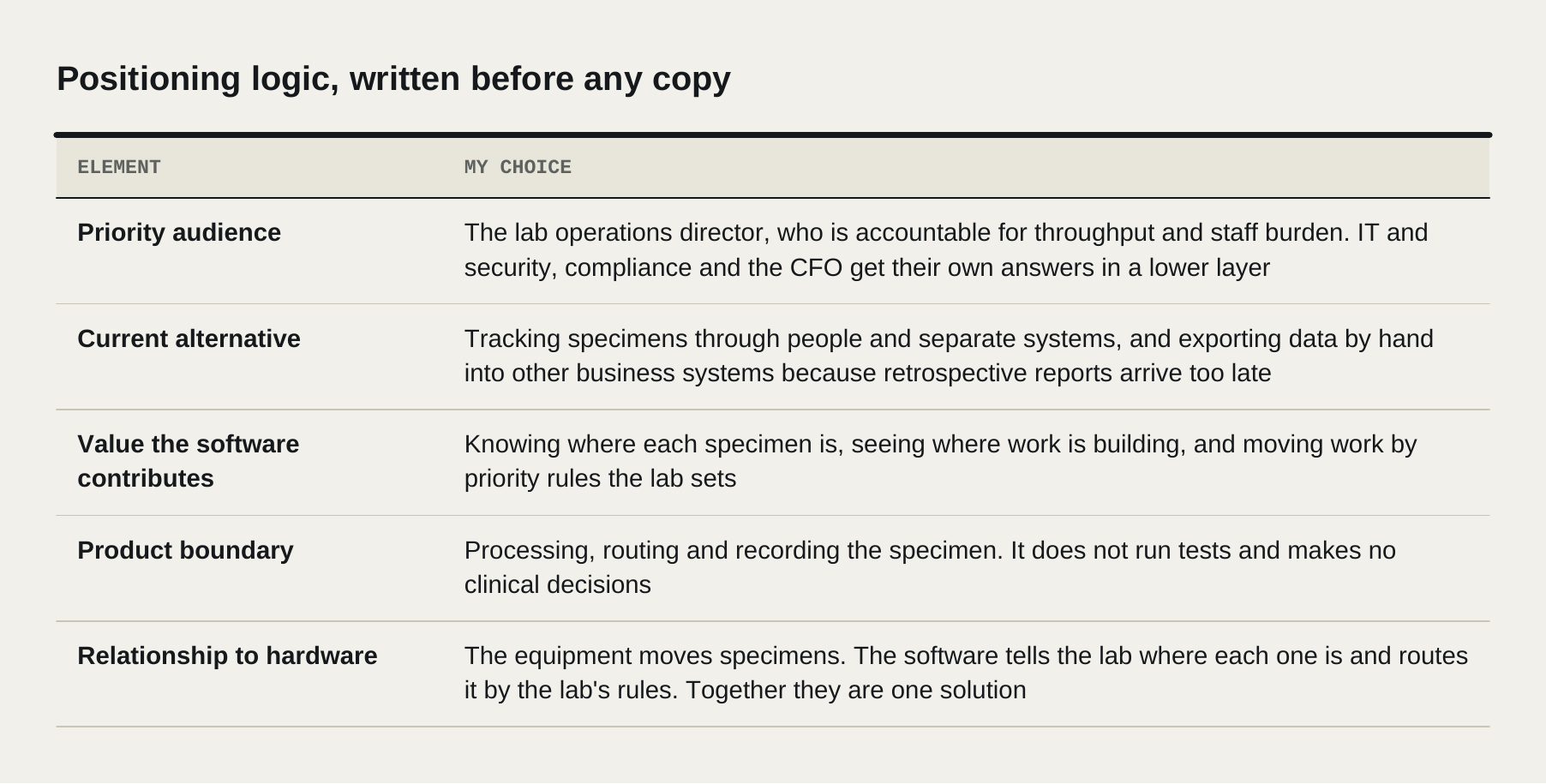
This table made the product boundary explicit: Linesight directs specimen flow within lab-defined priorities; it does not make clinical decisions or promise capacity gains.
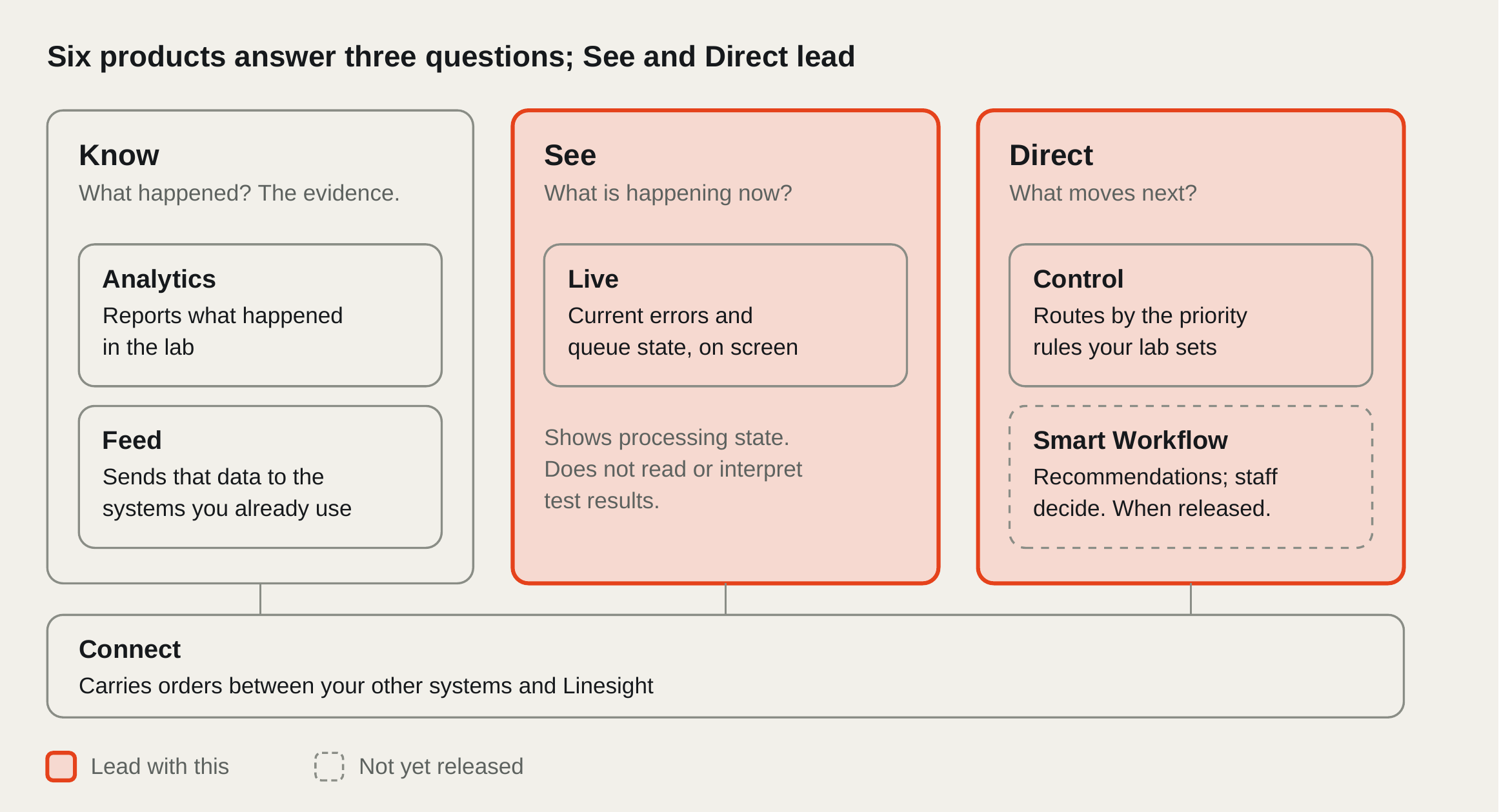
I organized the portfolio around three buyer questions — Know, See and Direct — rather than asking reps to lead with six product names. The frame began as an AI suggestion, but I kept it because each question matched a real operations concern and could be tied to established capabilities. I then mapped Analytics and Feed to Know, Live to See, and Control to Direct. Smart Workflow remained clearly future-facing: it would add recommendations after release, while staff would decide whether to act.
The map turns the portfolio into recognizable jobs, so a rep can start with the buyer’s task and name the product second.
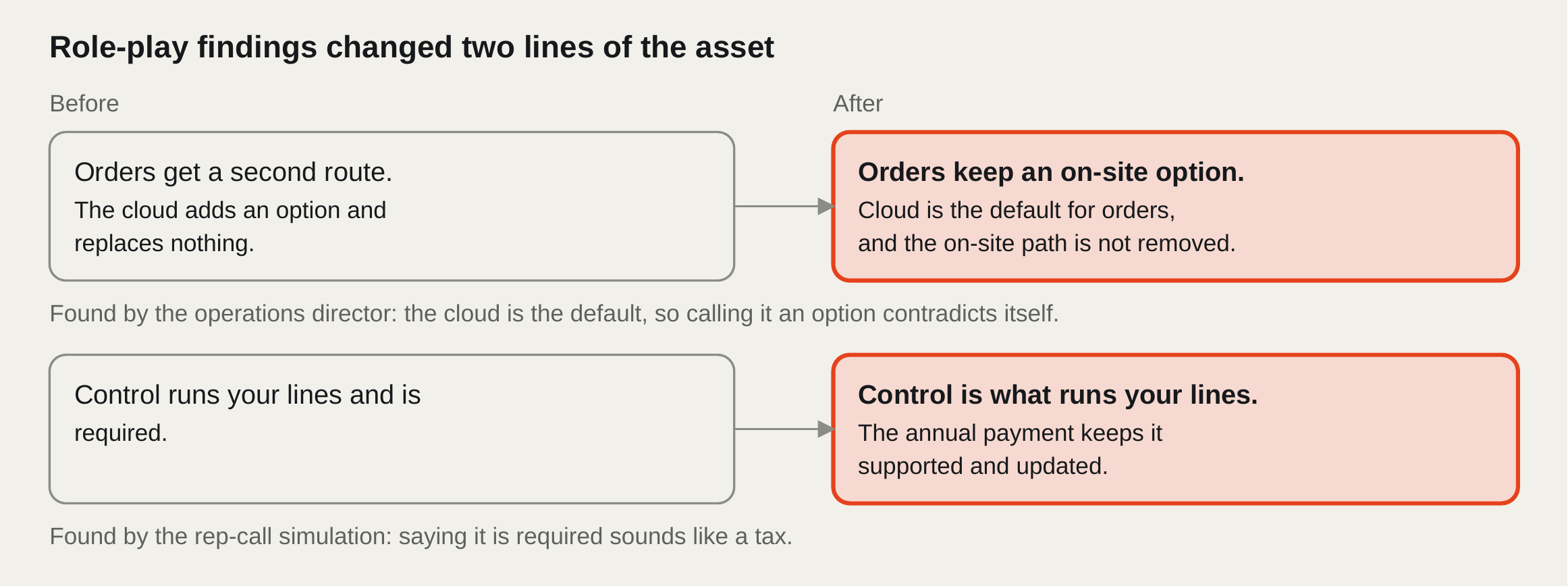
I adapted the opening, proof and next step to each customer’s situation, keeping existing bundle entitlements fixed. Then I pressure-tested the asset with Claude role-play and four blind sub-agents representing operations, IT and compliance, a CFO and a rep. Their feedback exposed unsupported answers, contradictory cloud wording and internal coaching language that would damage trust. I revised the asset and marked unresolved facts for product, security and finance to confirm.
The role-play showed me where a seller or buyer would still be unsupported, which made the next revision more honest and usable.
Connected document search surfaced reference material on software bundling and security documentation. I used it to give the fictional scenario a realistic structure, then decided what to adapt and what to leave out rather than importing generic best practices.
Finally, I used document and file tools to build the positioning document, playbook, and case study as editable assets. They mattered less for strategic thinking than for turning the framework into something a rep could actually use. The load-bearing tool was the role-play process: it exposed the gaps that made the asset more honest and more practical. I would use AI again for this kind of pressure-testing, but I would pair it with real customer and seller evidence before treating any value claim as validated.
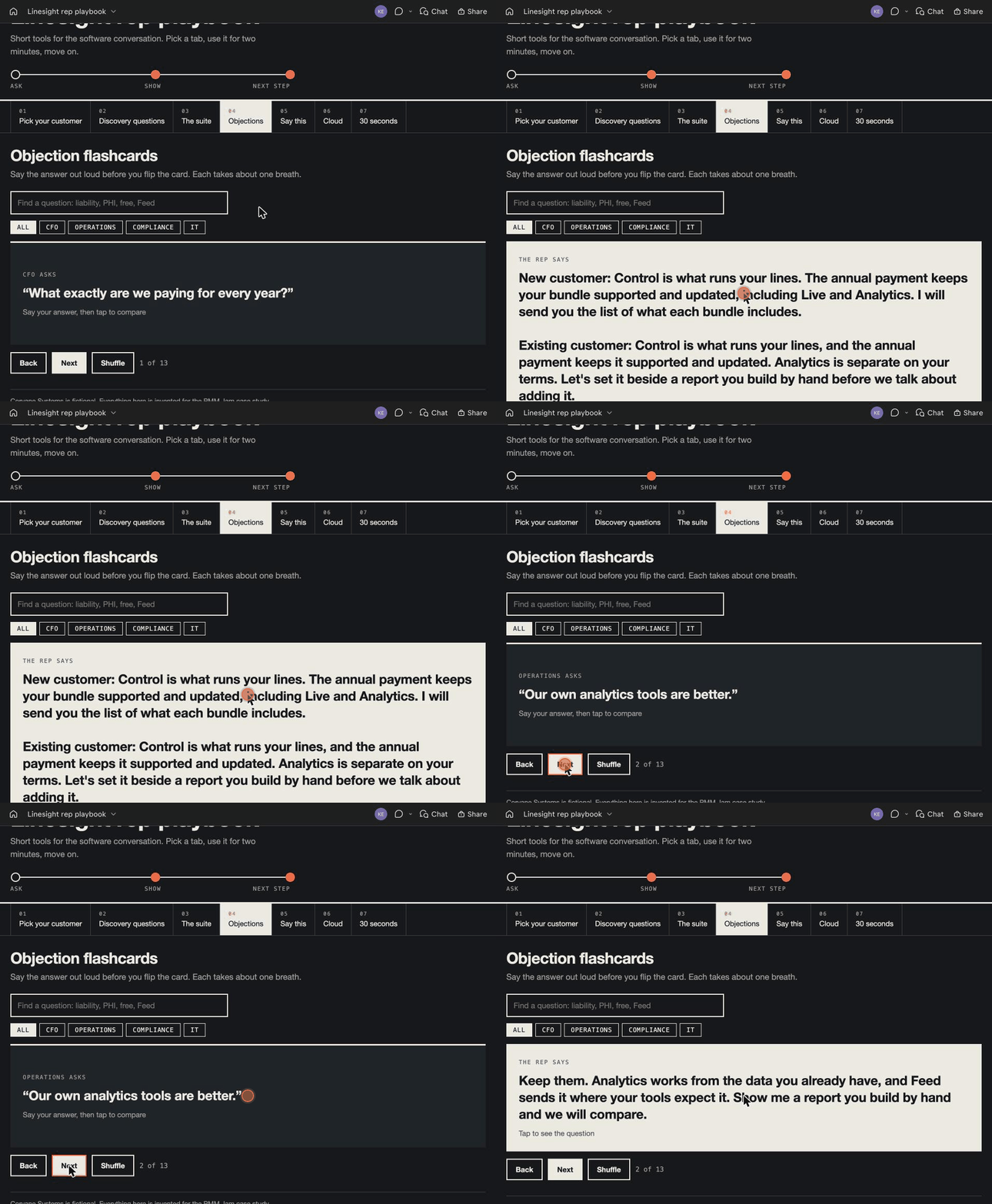
Objection Flashcards: These turn unresolved buyer questions into practice prompts and make gaps visible before a customer call.
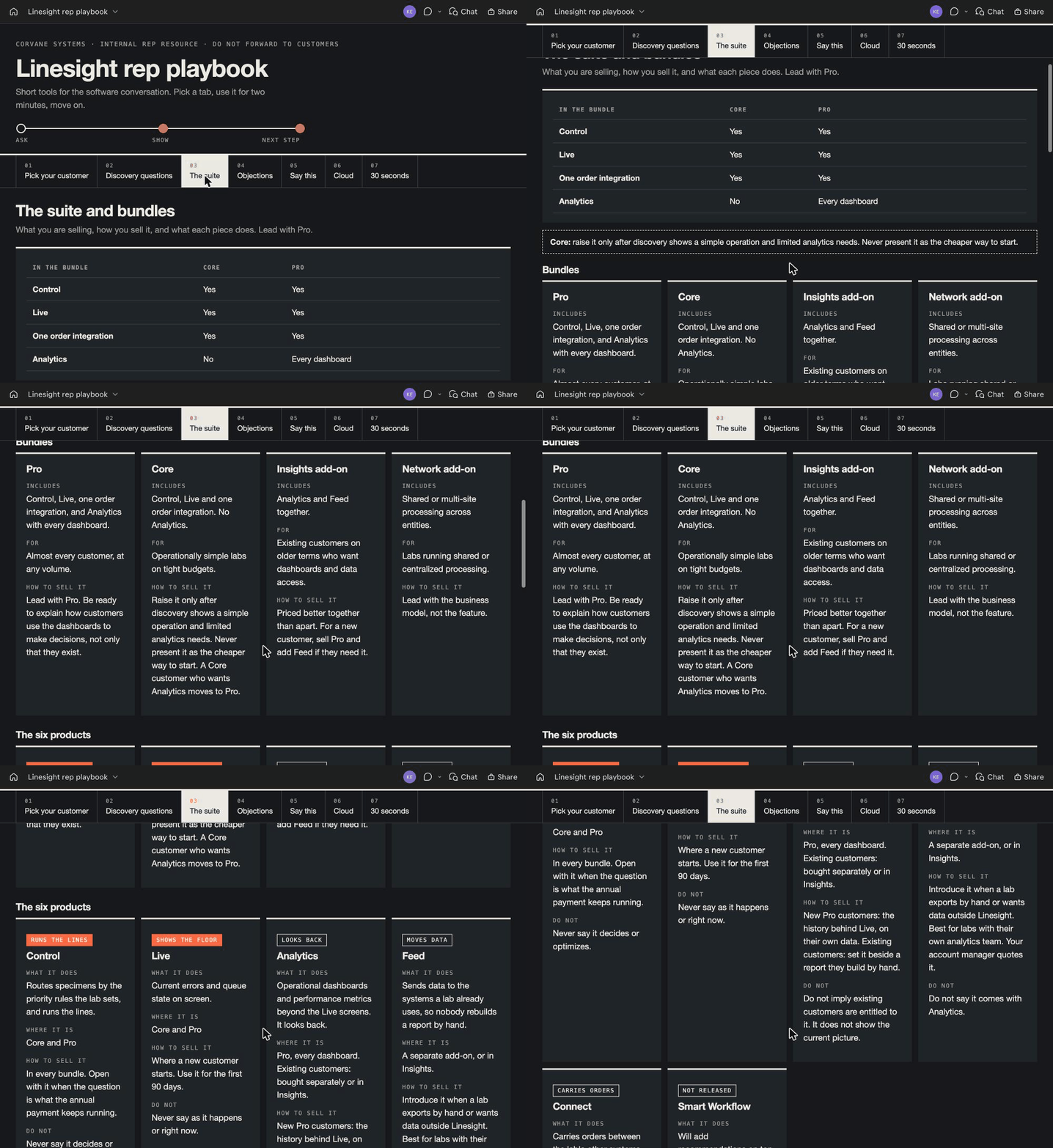
Software Suite Overview: This gives a solo PMM a reusable reference for keeping product, suite and bundle language consistent as the portfolio changes.
Donna set out to unify SKILLFRAME’s sales message and help reps overcome LMS-related objections. They interviewed stakeholders, reviewed sales and marketing materials, used AI to build a Clarity Framework, and created pe Read more
Emmanuella set out to build PATCHWORK’s three-year go-to-market roadmap and investment case, combining segment analysis, positioning, pricing, financial modeling, and evidence-based funding gates to validate repeatable g Read more




Comments
No comments yet. Be the first to share what you think.