Loading case study…
Portfolio Marketing Manager at HP, Inc.
Wrenchline is a field service management platform for trade contractors (plumbing, HVAC, electrical) - the companies that send technicians to your house when something breaks. Founded in 2012, bootstrapped, profitable, roughly 1,800 customers. The product does scheduling, dispatch, invoicing, and job tracking. It works offline, a new tech can learn it in a day, and it has never lost a customer's data.
Discover how this approach could help you reach your professional goals.
or share this case study with your network
Portfolio Marketing Manager at HP, Inc.
Fractional Marketing Consultant
Bonnie developed a three-year GTM roadmap for Pulsara, focusing on heart-failure deterioration prediction among regional health systems. They designed conversion-focused pilots, evidence-based milestones, and staged team Read more
The buyer is not a software buyer. The buyer is a plumber who runs a shop with five to fifty trucks and wants to spend less time on paperwork and more time running jobs. They chose Wrenchline because it does what they need without getting in the way.
Over the past year, nearly every major competitor in the field service category relaunched as "AI-powered." ServiceTitan introduced an "AI Max" package and started calling itself the AI future of the trades. Jobber added an AI Receptionist. Housecall Pro shipped AI-driven call answering, route optimization, and lead scoring. The marketing got louder. The category conversation shifted from "does your software solve my daily problems" to "is your software modern enough to keep up."
Wrenchline didn't add AI features. It kept building what its customers asked for: the scheduling and dispatch and invoicing that keeps a five-truck plumbing company running, but churn ticked up.
The natural read here is that it's a product problem: competitors added AI, customers are leaving, so Wrenchline needs AI features too. I'd push back on that.
Customers aren't leaving because they tested a competitor's AI features and found them better. They're leaving because the category conversation changed around them. When three of your four competitors say "AI-powered" and you say nothing, the silence becomes the message. Prospects and existing customers start to assume you've fallen behind, even when the product hasn't changed.
This is a positioning problem, not a product problem, and the distinction matters because the two lead to completely different solutions.
To confirm that diagnosis, I worked through the competitive landscape with a specific question: are the AI features competitors are marketing actually solving the problems that made contractors switch software in the first place? The answer, consistently, was no.
ServiceTitan's AI Max package sits on top of a platform that contractors still describe as painful to onboard, expensive to maintain, and slow to get support from. Those complaints predate the AI additions. The AI layer didn't fix them.
Jobber's AI Receptionist launched in August 2025. The core user complaints (limited customization, pricing jumps at renewal, scheduling gaps) predate the AI entirely. The AI is a new feature on an old set of problems.
Housecall Pro is the most interesting case. They have real AI features with generally positive reviews. Their AI call answering rates well (4.4 out of 5), but the question is what problem it actually solves. It might save a contractor a headcount, and that's a real benefit, but it's not the same as solving the reason contractors switch field service software in the first place. Contractors switch because scheduling breaks, invoices don't go out, or the software costs more every year. A well-reviewed add-on feature is a nice thing to have, not a core operations fix.
Of course, Wrenchline probably has its own integration bugs and its own support tickets, like all software products. If the case against competitors rests on "their software has problems," that's not positioning, that's a glass house. The case has to rest on something specific to the AI conversation: competitors are marketing AI features that don't address the operational problems contractors actually have, and the marketing is creating a perception gap that makes reliable products like Wrenchline look outdated by comparison.
So the real question isn't "what feature should Wrenchline build?" It's "what story does Wrenchline need to tell, and to whom?" The product hasn't changed, the conversation has. Wrenchline needs a story that makes its existing strengths matter again in that new conversation.
The brief also surfaces a second job that's easy to conflate with the first: sales reps are hearing "where's your AI?" on calls and don't have a confident answer. That's related to the positioning gap, but it needs its own deliverable. A positioning framework tells the organization what the story is. A sales redirect script puts that story in a rep's hands on a live call. The framework I built includes both, as separate sections, because they serve different people in different moments.
The underlying PMM skill here is positioning in a shifting market. The category conversation changed, and Wrenchline's real strengths stopped being visible in that new conversation. The job is to build a positioning framework that makes those strengths matter again, and then arm the rest of the organization (sales, retention, marketing) to use it.
Why a positioning framework, and not something else.
The brief asks for an asset that stops the churn and gives sales a confident answer to "where's your AI?" There were several ways to interpret that, and I want to name the ones I didn't take before explaining the one I did.
A sales battle card. [Rejected] This would give reps something to say immediately, but it wouldn't solve the underlying problem. A battle card without an upstream positioning stance is just a collection of talking points with no strategic spine. What do the talking points add up to? What's the story they're all serving? Without answering that first, every piece of sales collateral is making it up as it goes.
A retention playbook. [Rejected] Win-back emails, at-risk account scripts, a save offer. That addresses the churn symptom directly, but it doesn't address why the churn is happening. You can write a great retention email, but if the positioning underneath it isn't clear, the messaging won't tell a cohesive story. Each email is improvising its own version of why Wrenchline matters, and the customer hears a different answer every time.
Both of these are assets without strategy. They're downstream of the real problem, and building them first means building them without a foundation.
Build new AI features. [Rejected] This is where the competitive research and customer insight actually matters. Based on the diagnosis in the Challenge section, contractors aren't leaving because they evaluated Wrenchline's capabilities and found them lacking. They're leaving because the conversation shifted toward AI and Wrenchline had nothing to say. The competitive evidence backs this up: the AI features competitors are marketing aren't solving the core operational problems that make contractors switch software. Wrenchline doesn't need to change the product. It needs to change the story. On top of that, Wrenchline is bootstrapped and profitable. Building an AI feature set to compete head-on with ServiceTitan and Housecall Pro would take months, cost capital they're not looking to burn, and land them in a feature war against better-funded competitors on their own turf.
What I chose and why.
I built a positioning framework: the strategic foundation that every downstream asset (battle cards, retention messaging, website copy, sales scripts) can draw from. The positioning stance is "above the hype." It doesn't fight the AI conversation and it doesn't join it. Instead, it redirects the conversation to ground Wrenchline wins on: does your software actually solve your daily problems, or does it just sound like it should?
The reasoning: Wrenchline's real strengths (works offline, simple to learn, reliable data, predictable pricing) are specific and provable. The competitors' AI claims are, in most cases, vague and hard to verify. In a conversation about "who has better AI features," Wrenchline loses. In a conversation about "whose software actually solves the problems you bought it to solve," Wrenchline wins. The positioning framework moves the conversation.
There are three main stances Wrenchline could take:
Option 1, "Against the hype" [rejected]
Position Wrenchline as the anti-AI choice. Rejected because it creates a ceiling. If AI ever does solve a real contractor problem (and it might), Wrenchline has boxed itself into a stance it would have to reverse. It also risks sounding defensive, which reinforces the perception that Wrenchline is behind.
Option 2, "Alongside the hype" [rejected]
Add light AI features and market them. Rejected because Wrenchline would be last to a party everyone already arrived at, with a weaker version of what competitors already claim. This doesn't play to any strength Wrenchline has.
Option 3, "Above the hype" [selected]
Instead of fighting the AI conversation or joining it, change it. Reframe the question from "does your software have AI?" to "does your software solve your problems?" This plays to Wrenchline's real, provable strengths. It doesn't require trashing AI or pretending it doesn't exist. And it leaves room to add AI features later if they genuinely solve a contractor problem, without having to reverse the positioning.
I used Claude (Anthropic) throughout this project. Here's where AI helped most, and where human judgment made the difference.
What AI did well. AI was useful for the parts of this project where speed and breadth matter more than judgment. It pulled and organized competitive research across ServiceTitan, Jobber, and Housecall Pro faster than I could have done manually. It drafted initial structures for the framework sections. It generated multiple variations of messaging pillars and taglines that I could react to and edit rather than starting from a blank page. And it helped me stress-test my own thinking by playing devil's advocate when I asked it to poke holes in my positioning stance.
Where I overruled it, and why.
The interesting part of working with AI on a positioning project isn't what it produces, it's what you catch. Here are the corrections that mattered most:
The tool I built. I also used a messaging audit tool I'm developing to analyze the competitive messaging landscape. The tool scores messaging across structured dimensions and surfaces specific claims with evidence. I used it to pull the competitive data that fed the diagnosis in the Challenge section. It's worth noting that the tool surfaced findings I then had to verify and, in several cases, correct. The tool gave me speed and coverage. The judgment calls about what was actually true, what was overstated, and what to do about it were mine.
The honest summary. AI drafted the framework, and I edited heavily. It contributed speed, breadth, and structure. I brought the positioning stance, the competitive diagnosis, and the judgment calls listed above, which came from applying PMM fundamentals (know the customer, know the competition, be honest about both) to a specific company in a specific market moment.
The full positioning framework is included here. Below, I'll walk through what it contains, why it's structured the way it is, and what Wrenchline would do with it over the next 90 days.
What the framework covers.
The document has eight sections. The first three (executive summary, diagnosis, strategic positioning) build the argument: here's what's happening in the market, here's why it's a positioning problem and not a product problem, here are the three stances we considered, and here's why "above the hype" is the right one for this company.
The core positioning framework is a structured statement (for / who need / Wrenchline is / unlike / because / so that) that gives everyone in the organization the same foundation to build from. It's followed by three messaging pillars, each rooted in a provable Wrenchline strength:
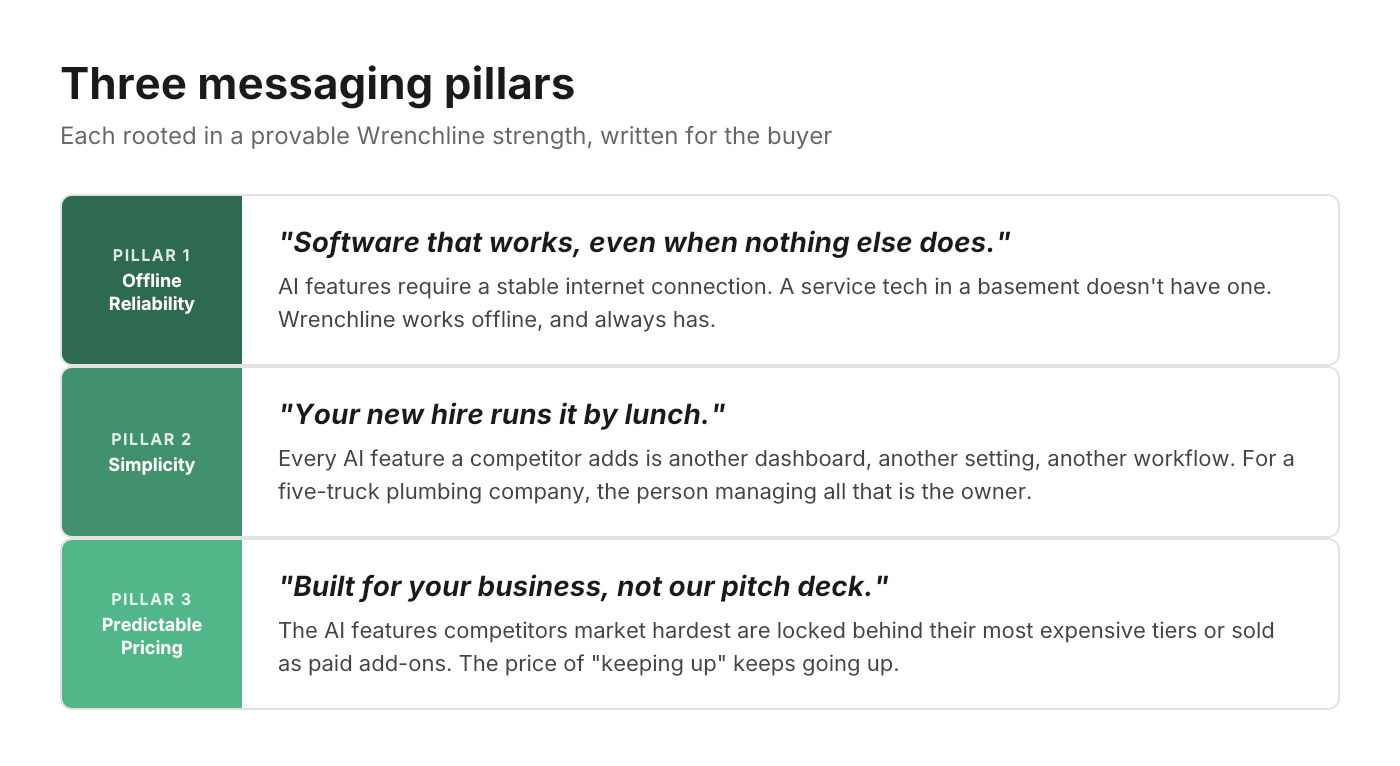
A note on scope: This framework is built for a specific competitive moment, not as a replacement for Wrenchline's existing company messaging. The category conversation shifted around AI, and this is the response to that shift. Think of it as a targeted play (like a competitive response playbook) that sits on top of whatever brand and product messaging Wrenchline already has in market. The first two pillars draw on enduring product strengths. The third is most directly tied to the current AI conversation. At the 90-day mark, the question is which parts of this competitive response proved durable enough to fold into the company's broader messaging, and which were specific to the moment.
Each pillar includes headlines, descriptions, supporting proof points, and customer language examples, all written for the buyer (a trade contractor), not for a software audience.
The last three sections are where the framework turns into operational tools. Sales enablement gives reps a three-step redirect for "where's your AI?" (acknowledge, redirect, land) with scripts tailored to three prospect types: the price-sensitive owner, the growth-minded owner, and the recently-switched-back prospect. Retention and win-back messaging covers proactive outreach for at-risk accounts, competitor comparison framing, and a 30-to-60-day win-back message timed to hit the post-honeymoon window when onboarding pain at the new platform is real. The voice and tone guide keeps everything consistent: concrete over abstract, the customer is the hero, honest over polished.
Why this solves the problem.
The positioning and messaging pillars give Wrenchline a story that makes its real strengths visible again in a category conversation that had moved past them. The story isn't "we don't have AI," it's "we solve the problems you actually have." The sales enablement section turns that same positioning into something reps can use on a call tomorrow: a confident redirect for "where's your AI?" that doesn't sound defensive and doesn't trash AI. Both draw from the same strategic foundation, which is why they're in one document, but a sales rep doesn't need to read the brand positioning theory to use the cheat sheet that comes out of it.
What's deliberately not in here.
The framework doesn't include a sample battle card, a homepage rewrite, or campaign creative. Those are real next steps, but they're downstream of the positioning. The whole argument of this project is that Wrenchline's problem was upstream (no positioning story for a changed market) and the solution needs to start upstream too. Building the downstream assets first would mean building them without a strategic spine, which is what the Approach section argued against.
What the framework does include is enough structural detail (messaging hierarchy, proof points, scripts, voice guidelines) that a team could build those downstream assets from it. The positioning is the foundation, and the battle cards, website copy, and retention emails all follow from it.
30/60/90: what happens after this ships.
Days 1 to 30: Internal alignment and quick wins. Priority: get the "where's your AI?" redirect into reps' hands and align the team on the positioning stance.
Days 31 to 60: Retention and competitive collateral. Priority: proactive retention outreach and building the downstream assets the framework was designed to feed.
Days 61 to 90: Measure and adjust. Priority: close the loop between strategy and results.
The framework is a starting point, not a final answer, and the 90-day mark is when you know whether it's working and what should stick.

Product Marketing Manager in Education
Donna set out to unify SKILLFRAME’s sales message and help reps overcome LMS-related objections. They interviewed stakeholders, reviewed sales and marketing materials, used AI to build a Clarity Framework, and created pe Read more
Product Marketing Manager in Technology & Software
Emmanuella set out to build PATCHWORK’s three-year go-to-market roadmap and investment case, combining segment analysis, positioning, pricing, financial modeling, and evidence-based funding gates to validate repeatable g Read more
Comments
No comments yet. Be the first to share what you think.