Loading case study…
NovaFund: Prioritising the next buyer persona through a persona scoring model and an interview guide

Hani ShoaibNovember 22, 2026
Product Marketing Manager
Views (30)
Show summary
- NovaFund sells accounting software to small and mid-sized businesses but markets broadly to CFOs, despite serving diverse buyers with different financial responsibilities.
- The team needed a repeatable way to identify the most commercially valuable persona, despite messy segmentation and customer data excluding prospects and dissatisfied accounts.
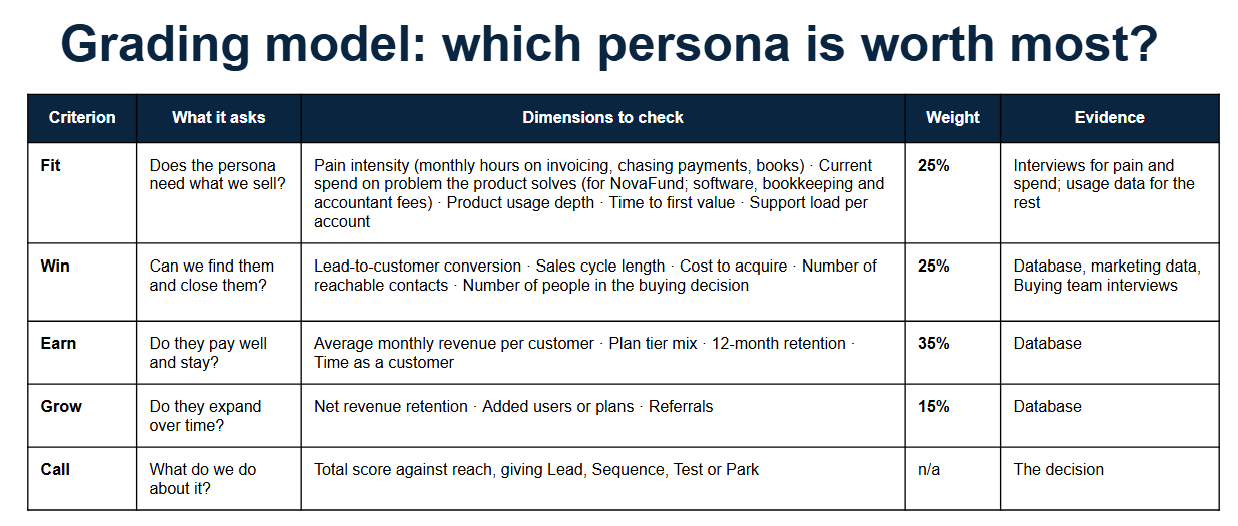
- They scored personas across Fit, Win, Earn, and Grow using quintile metrics, then paired the model with interviews capturing pain, spending, and buying dynamics.
- Claude refined and tested the logic, HubSpot generated profiles, Miro hosted reusable interviews, and Sheets contained adjustable scoring formulas, evidence, and sensitivity testing.
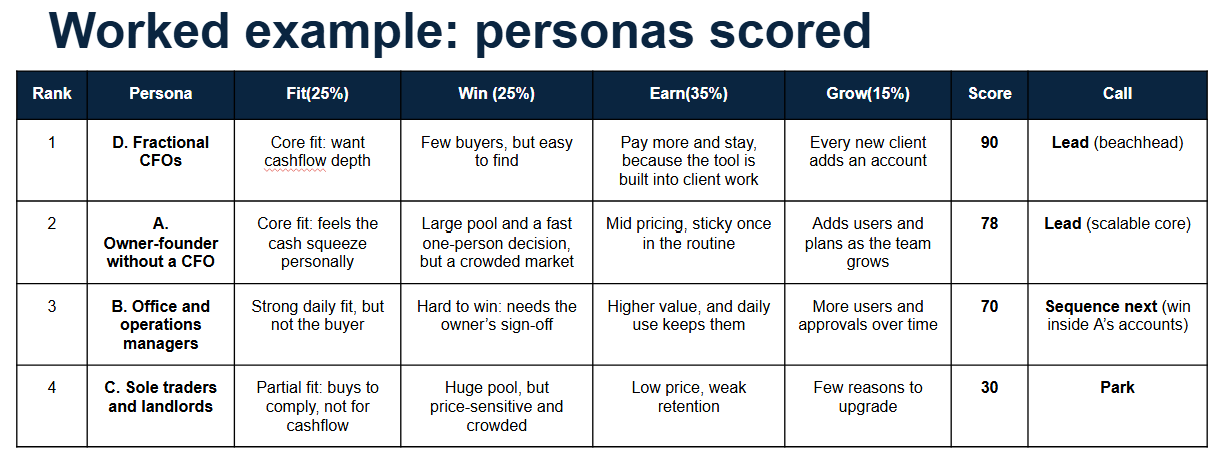
- Fractional CFOs ranked first at 90, followed by owner-founders at 78, while interviews should investigate the narrow eight-point gap separating second and third.
The context
Most companies know who their customers are in a general way and much less precisely who they should be going after. NovaFund, a fictional company we invented for this case study, shows how that plays out. It sells accounting software to small and mid-sized businesses, and for years its marketing has been written for one person, the CFO.
Small businesses rarely have a CFO in the sense a larger company does. Open NovaFund's customer database and you find owner-founders who do the books on a Sunday evening, operations managers who spend their weeks chasing late invoices, fractional CFOs who look after the finances of a dozen clients at once, and sole traders who signed up because a filing deadline gave them no choice. All of them are filed under one job title, and the marketing team has no agreed way to say which of them deserves the next pound of budget.
The challenge
Beyond the CFO, the audience NovaFund already sells to, we (my PMM Jam Partners) @Mark Maximos, @Anna Dauksa and I) set out to find which persona would bring the company the most commercial value, and to answer it in a way the team could repeat each quarter instead of settling it by whoever argued best in the planning meeting.
Two things made this hard. Small businesses do not sort cleanly into segments, because a company's size, sector and the way its owner happens to have organised things all shift who ends up handling the money. And the customer database, however good, only describes people who already bought. It says nothing about the owner who would have bought had anyone reached them, or the customer who looks valuable on paper and is quietly shopping around.
So the work had two halves. We needed a scoring model that ranks personas using data the company already holds, and an interview method that fills in what that data cannot show.
The approach
The tools
Claude worked as a sparring partner on refining the model's logic. It helped us put the quintile scoring and the weighting into plain terms, pressure-tested the reasoning behind each weight, and then we built the workbook with live formulas with its help. We also had it check the result by changing the inputs and watching whether the rankings moved as they should.
HubSpot's persona generator produced the detailed persona profiles shown on the slides. It gave the team a fuller picture of each candidate than a job title does, so that the scoring model had recognisable people to evaluate. The model then ranks those personas, and the interviews should check the picture against what real customers say.
Miro holds the interview guide, one for each stage of the conversation, with space for answers on stickies during the call. A single board serves prospects and existing customers, and the same layout can be carried into another industry.
Sheets holds the scoring model. The weights, the cut-offs and the action thresholds are all cells that anyone on the team can change, next to an evidence tab for database metrics and interview answers, and a weight test that shows whether a ranking survives a five-point shift between criteria.
The result
The first pass puts fractional CFOs at 90 out of 100, owner-founders without a CFO at 78, office and operations managers at 70, and sole traders and landlords at 30. That gives Lead, Lead, Sequence and Park. Fractional CFOs work through client after client and so keep adding accounts, while sole traders tend to buy to meet a deadline and leave once it has passed.
In the example case (NavaFund) the 8-point gap between the second and third personas is the number to watch. It is small enough for a different weighting to swap them, which makes it the first place where interviews should be pointed.
What we have is a scoring workbook, a persona-free interview guide that works for prospects and existing customers, and a way of working in which the model says where to look and the conversations say why. You may decide different weights to the criteria based on your industry or what your team agrees on collectively.
Like this approach?
Discover how this approach could help you reach your professional goals.
or share this case study with your network
Author
Hani ShoaibNovember 22, 2026
Product Marketing Manager
Views (30)
Discover more on Dusted

Bonnie Taylor6h ago
Fractional Marketing Consultant
Healthcare
Creating The Category That Builds The Room - A GTM Roadmap for Pulsara
Bonnie developed a three-year GTM roadmap for Pulsara, focusing on heart-failure deterioration prediction among regional health systems. They designed conversion-focused pilots, evidence-based milestones, and staged team Read more
0
Views (4)


Comments
Product Marketing Manager
ICP grading model template: https://docs.google.com/spreadsheets/d/15Nd-bGa0grCEw0SNfKaIGWSv10hSQy8_/edit?usp=sharing&ouid=112528945630022221643&rtpof=true&sd=true
Interview Guide: https://miro.com/app/board/uXjVELOEzDs=/?share_link_id=446169370963