Loading case study…
⚔️ Turning Competitive Intelligence Into Deals Won

Brianna CabralNovember 10, 2026
Senior Product Marketing Manager at Arena, by PTC
Views (77)
Show summary
- Arena’s competitive intelligence program replaced scattered knowledge with a structured system for helping sellers navigate crowded PLM and QMS markets.
- The program needed to prioritize meaningful competitors, replace generic feature lists with actionable proof, and make current intelligence usable during deals.
- Crayon-powered battlecards combine AI-updated competitor insights, win-loss evidence, call clips, tailored positioning, and automated deal briefs with ROI calculators.
- Crayon, Arena release-note battlecards, MCP-connected Claude and Copilot, win-loss interviews, call clips, and scheduled AI deal-brief automation power delivery.
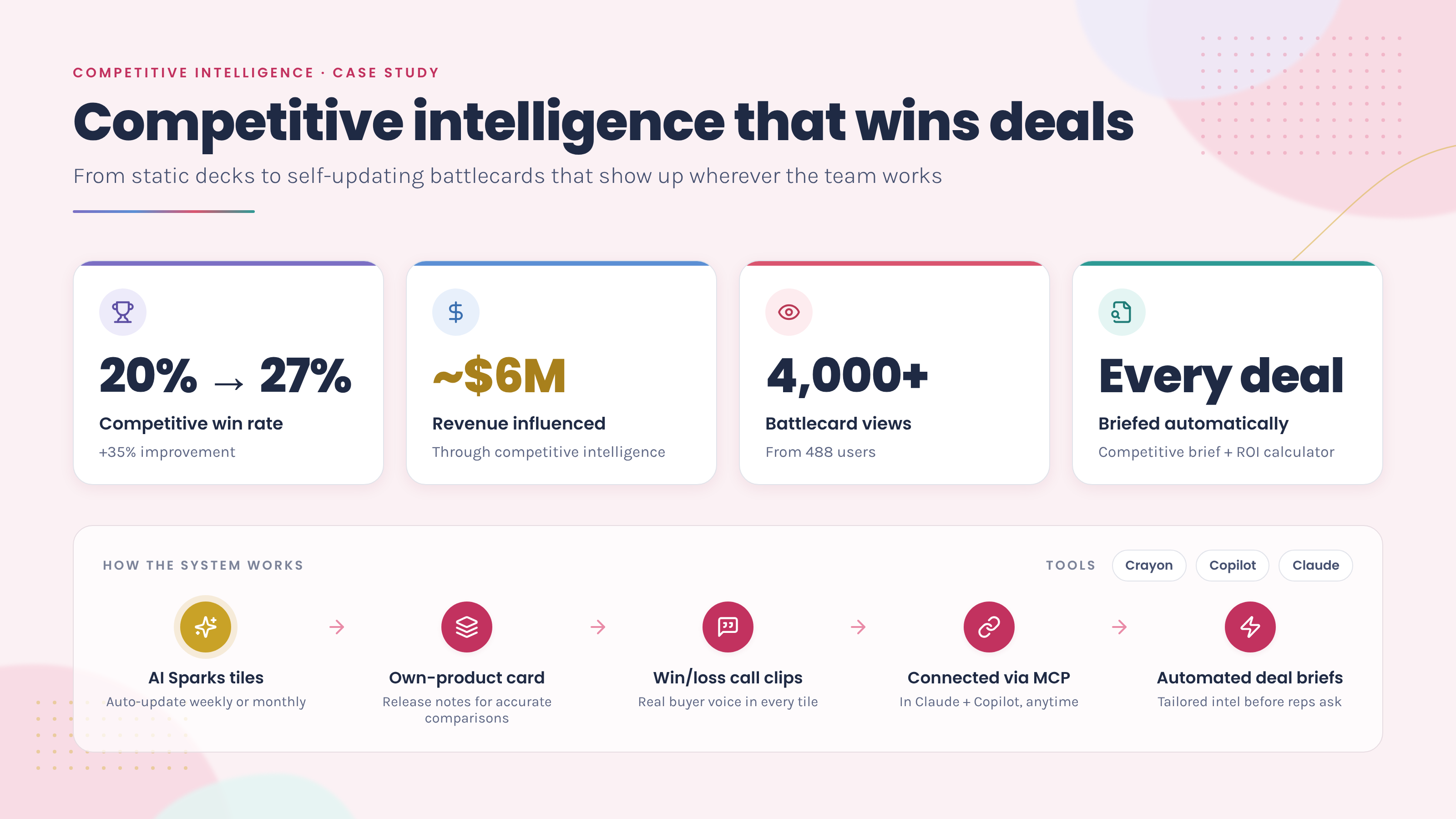
- Competitive win rate increased from 20% to 27%, CI influenced approximately $6 million, and battlecards attracted 4,000-plus views from 488 users.
The context
I built and run the competitive intelligence program at Arena, by PTC, a cloud-native PLM and QMS platform for manufacturers. Our buyers are engineering, quality, and operations leaders evaluating a crowded market: established enterprise vendors moving to the cloud, newer SaaS challengers selling simplicity and low upfront cost, QMS-only specialists, and the most common competitor of all, doing nothing and staying on spreadsheets, shared drives, and paper.
When I started, competitive knowledge lived in people's heads and scattered files. Reps went into competitive deals with whatever they remembered, every competitor claimed the same things (collaboration, compliance, end-to-end lifecycle), and we had no consistent way to tell sellers who actually mattered or how to win against them.
The challenge
I owned competitive intelligence end to end: research, prioritization, battlecards, enablement, and proving that it changed outcomes.
The hard parts:
- Too many competitors, too little focus. Sales needed to know which competitors mattered most, not get a long list where every vendor looked the same.
- Generic feature comparisons don't win deals. Every vendor's checklist looked alike. Reps needed specific questions, proof points, and examples, not a spec sheet.
- Intel that doesn't get used is worthless. A 30-page PDF that no one opens doesn't change win rate. It had to be easy to find in the middle of a deal and kept current.
Success meant a higher competitive win rate, revenue influenced by CI, and battlecards that sellers actually used.
The approach
1. Evaluated and purchased Crayon, then built battlecards that update themselves. I evaluated and purchased Crayon as our competitive intelligence tool. Every battlecard is built on Crayon's AI Sparks: curated insights paired with prompts that generate targeted response tiles. The tiles auto-update weekly or monthly, so reps always see current intel instead of a snapshot that goes stale the day it's published. Each card covers the competitor's target market, strengths and gaps, pricing signals, common claims and how to answer them, and land mines: discovery questions that expose a weakness, like asking a competitor to demo a full workflow live instead of in slides.
The tools
- Crayon (AI Sparks): our CI platform, where AI Sparks pair curated insights with prompts to generate targeted battlecard tiles that auto-update weekly or monthly.
- Arena battlecard with release notes: our own product view, kept current so comparisons stay accurate.
- MCP connection to Claude and Copilot: puts the full CI system inside the AI tools teams already work in.
- AI deal briefs + ROI calculator automation: a scheduled skill that generates a competitive brief and ROI calculator for each competitive opportunity.
- Win/loss interviews and call clips: the primary source of truth behind the positioning.
The lesson: the intel itself is only half the work. Delivery, meaning current, searchable, and available wherever people are working, is what turns research into wins.
The result
- Competitive win rate rose from 20% to 27% in one year, a 35% improvement.
- ~$6M in revenue influenced through competitive intelligence.
- 4,000+ battlecard views from 488 users, which shows that sellers rely on it, not just that it exists.
- Every competitive deal now gets an automated brief and ROI calculator, with no manual request needed. Notable win of 100k using the first generted deal brief.
- CI is now an always-on resource beyond sales, supporting product research, launches, email, and content through Claude and Copilot.
What I'd tell anyone building CI: build for the moment of need, keep it current automatically, and connect it to win/loss so the program learns from every outcome.
Like this approach?
Discover how this approach could help you reach your professional goals.
or share this case study with your network
Author
Brianna CabralNovember 10, 2026
Senior Product Marketing Manager at Arena, by PTC
Views (77)
Discover more on Dusted

Estela Machado Coppola23h ago
Product Marketing Manager in Technology & Software
Technology & Software
🎮 Repositioning a Gaming Data Leader to Win Beyond Gaming Without Losing Its Core.
Estela set out to reposition a gaming data company as a creator marketing analytics leader for brands and agencies while protecting its gaming credibility. They used research, buyer validation, cross-functional alignment Read more
2
Views (11)


Comments
Founder at Dusted
Those win-rate increases are impressive! Saving this one for sure!!