Loading case study…
Using AI to Predict a Competitor's Launch and Turn the Signals into Sales-Ready Talk Tracks

Shannon De MarcoNovember 12, 2026
Product Marketer in Technology & Software
Views (21)
Show summary
- Crayon’s competitive intelligence surfaced weeks of signals before Klue’s December 2025 teaser, validating its head-to-head monitoring against a primary competitor.
- Crayon needed to predict Klue’s launch, equip reps before announcement, avoid manual battlecard rewriting, and provide counter-positioning that survived public scrutiny.
- Sparks analyzed 30 days of cross-source signals, predicted an AI win-loss interviewer, generated talk tracks, and distributed them through existing rep workflows.
- Crayon Sparks synthesized site, content, and call data; Gong supplied conversation signals, while Slack, Salesforce, Teams, and ChatGPT delivered enablement.
- Klue launched as predicted, with talk tracks ready the day before, six-channel access, no manual upkeep, and a post achieving 12.8% CTA clicks.
The context
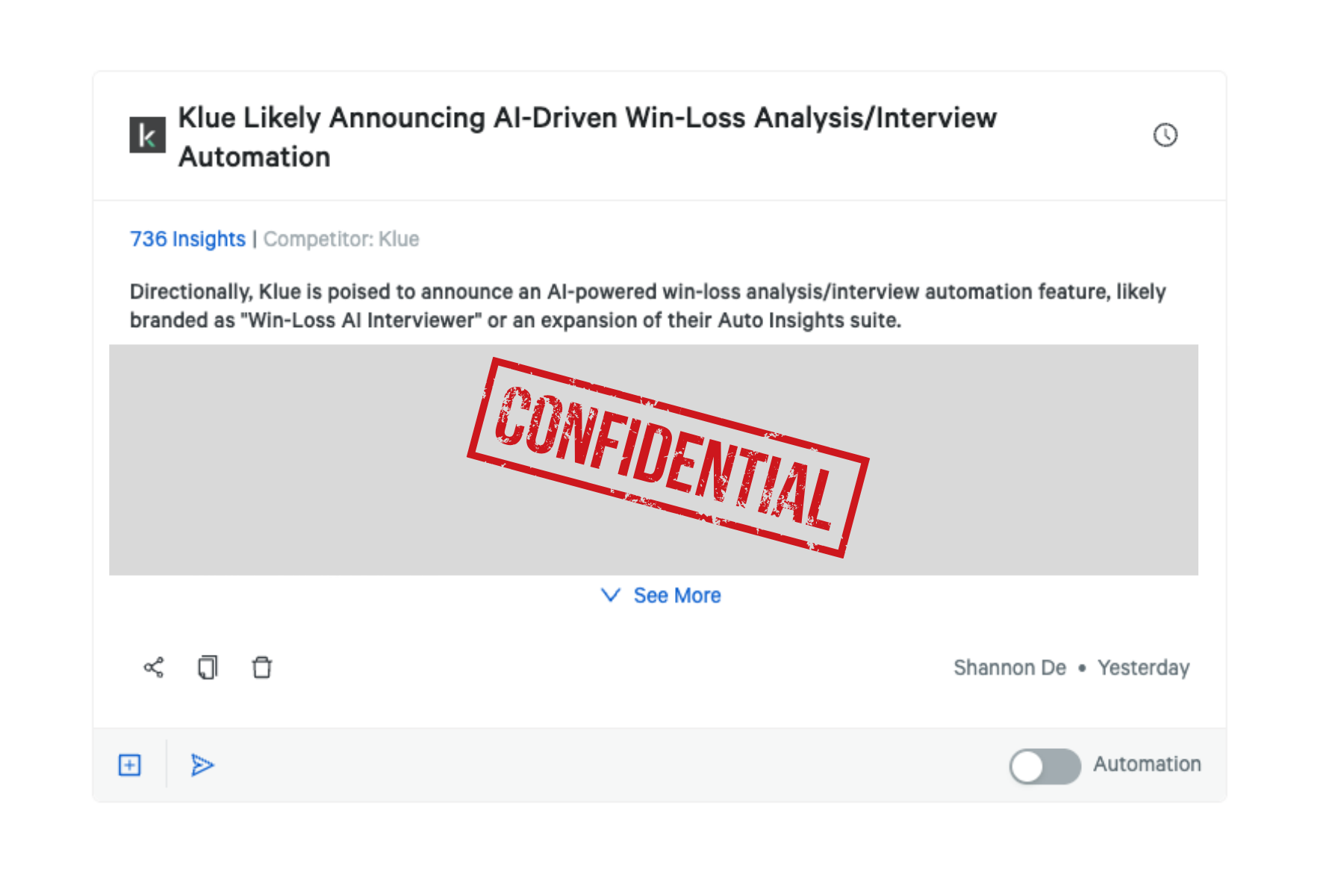
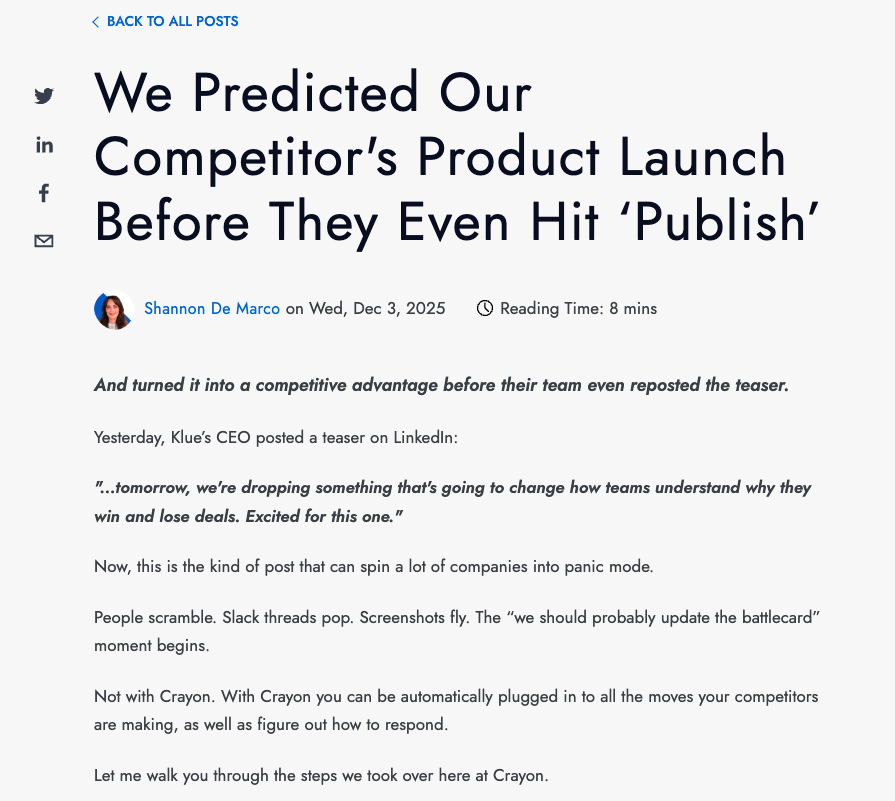
On December 2nd, 2025, Klue's CEO posted a teaser on LinkedIn. The following day they would be dropping something that would change how teams understand why they win and lose deals.
That kind of post sends most companies into panic mode. Slack threads pop, screenshots fly, and someone says "we should probably update the battlecard."
For us it was a confirmation. Crayon had been surfacing the signals for weeks.
Some context - I run product marketing at Crayon, a competitive intelligence platform, and Klue is our primary head-to-head competitor.
The challenge
A competitor launch is a race. The announcement goes out, and every rep with that competitor in a deal needs an answer ready before the prospect brings it up. The team that sees the move coming wins that race.
And we sell competitive intelligence. So this was a live test of our own product, in public, against our biggest competitor: could we spot the move before it happened and have reps armed before launch day?
Success meant three things:
- Reps armed before launch day, not after
- No manual rewrite of the battlecard to get there
- An answer that held up once Klue's launch was public
The approach
Weeks of signal: Our automated Sparks (Crayon's AI agent) run on a regular cadence and post into our internal Slack channels. For a few weeks they'd been picking up a pattern on Klue: subtle copy changes on their site, new themes in their blog content, chatter on our sales calls in Gong, plus what we saw on LinkedIn and review sites. Nothing concrete on its own, but enough to make us pay attention.
The tools
Crayon Sparks did the heavy lifting. The signal was already sitting in Crayon: weeks of Klue's site changes, content and call mentions. A Spark could read all of it in one pass and cite where each piece came from. A general-purpose LLM would have started from zero, and I'd have spent the afternoon pasting in context instead of building the response.
Gong supplied the call chatter. Prospects and customers mentioning Klue on calls was some of the earliest signal, and it's the kind reps trust most.
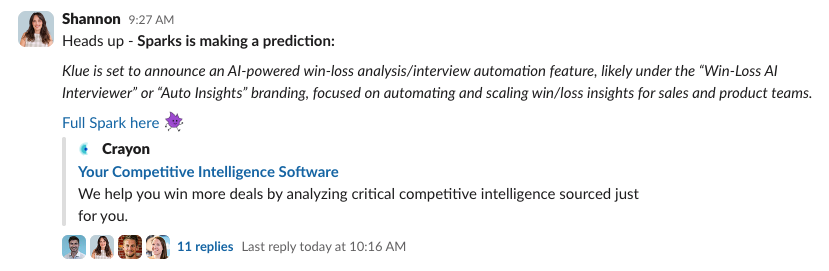
Slack was where the automated Sparks landed and where the prediction turned into a plan. The thread with our CPO and Director of Sales took minutes because everyone was already there.
Salesforce, Microsoft Teams and ChatGPT were delivery, not destinations. The talk tracks went to where reps already work, which is the only reason enablement gets used on a launch day.
The result
Klue launched its AI win-loss interviewer the next morning, and the prediction was right.
- Talk tracks ready the day before launch. The prediction posted at 9:27 AM, and reps had answers before Klue announced. The last time Klue shipped a big feature (March 2025), our talk track reached sales eight days after the announcement.
- Six places reps already work, not one portal.
- Needed right away. That same week, a rep shared a Klue proposal that bundled in win-loss surveys and AI. The answer was already on the battlecard.
- The blog outperformed our biggest news of the year. 639 views, a 12.8% CTA click rate and about four minutes average time on page. Our Gartner Magic Quadrant Leader announcement got a 5.8% click rate over the same period, so the prediction post drew more than twice the clicks per view.
Like this approach?
Discover how this approach could help you reach your professional goals.
or share this case study with your network
Author
Shannon De MarcoNovember 12, 2026
Product Marketer in Technology & Software
Views (21)
Discover more on Dusted

Estela Machado Coppola23h ago
Product Marketing Manager in Technology & Software
Technology & Software
🎮 Repositioning a Gaming Data Leader to Win Beyond Gaming Without Losing Its Core.
Estela set out to reposition a gaming data company as a creator marketing analytics leader for brands and agencies while protecting its gaming credibility. They used research, buyer validation, cross-functional alignment Read more
2
Views (11)


Comments
Senior Product Marketing Manager at Arena, by PTC
OMG amazing!! I need the prompt you use to find this info, so I can start monitoring ans surfacing in my Crayon!
Founder at Dusted
@Shannon De Marco! Please share? :)
Founder at Dusted
Now THIS is drinking your own champaign! Powerful proof!!