Loading case study…
Product Marketing & GTM Leader in Technology & Software
I was Lead Product Marketing Manager at Classy, a B2B software platform for nonprofit fundraising, and owned the product launch and go-to-market for Campaign Studio. I ran the beta program for three PMs so they could focus on the build, and led a 15–20-person launch team spanning product, marketing, sales, customer success, lifecycle, and operations.
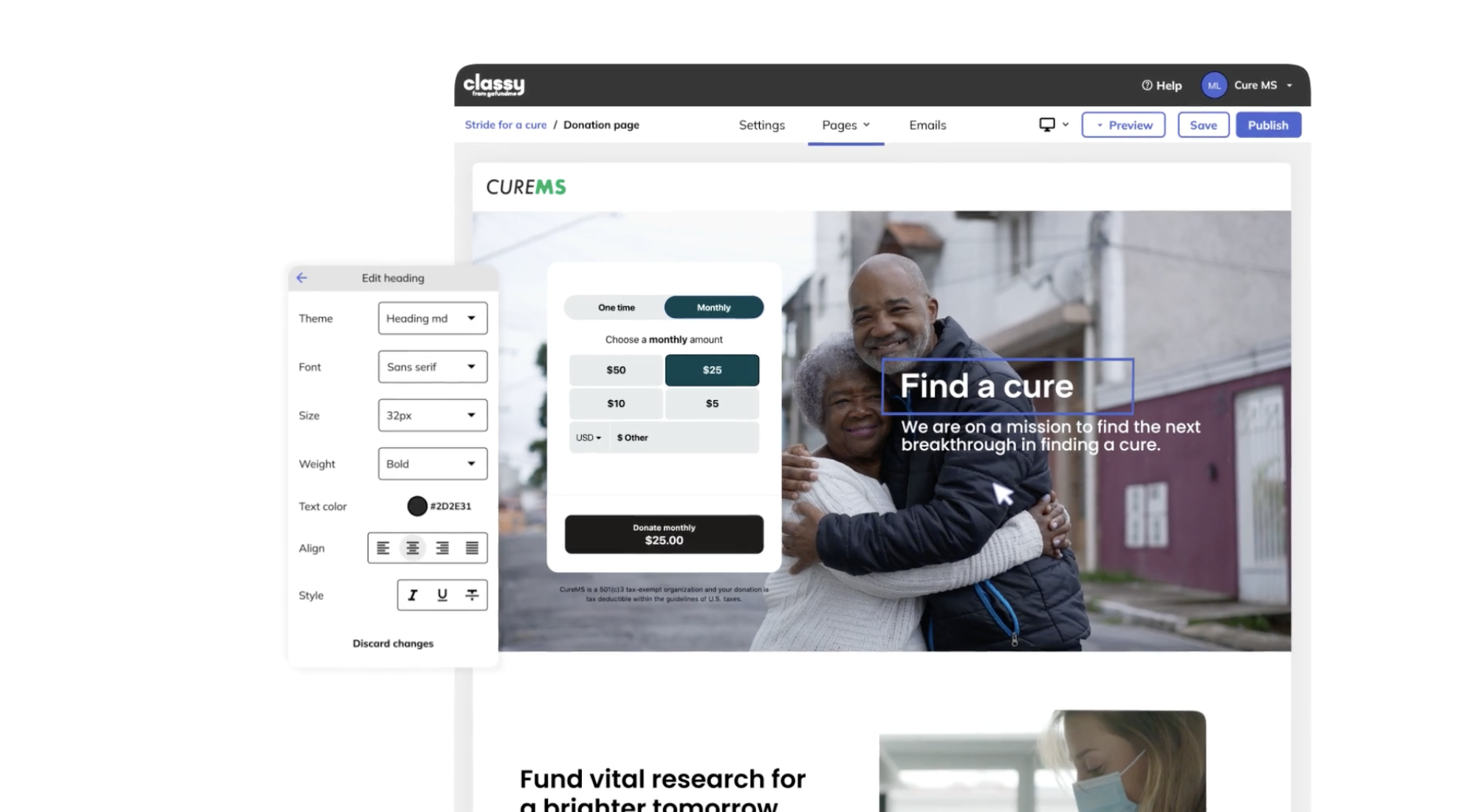
Studio reimagined and replaced the core of our product. The legacy platform used separate campaign types, like donation pages and crowdfunding. Studio merged them into one drag-and-drop builder with more design flexibility, better performance, and advanced features customers wanted.
That's the unspoken downside of product innovation: it can new naming conventions, navigation, and help content, with new website messaging, GTM assets, and a full-lifecycle re-education effort.
Classy's ultimate goal was to migrate every legacy campaign to Studio, a multi-year effort. My goal was more immediate: make Studio credible enough that customers would choose it for the giving season. Product owned the roadmap, release dates, and technical documentation. I owned positioning, messaging, the customer beta, and the full product marketing plan for a Tier 1 launch.
The plan assumed parity across campaign types by May or June. It landed in October. For eight months, I marketed a product that could do more than the legacy version in some ways and less in others, with release dates I didn't control.
Heading into Q4, Studio carried just 9% of direct-giving gross donation volume (GDV).
The most important tool was a single source of truth for a fast-moving product. With no dedicated resources, I built the feature matrix in Google Docs and published it as a PDF, so a single link from sales, support, and customer materials stayed current as releases shipped. Paired with the best-practices and year-end checklists, webinars, and use-case content, it gave teams the answer to “Can it do what I need?” and guidance on “What can I do now?”
Giving season turned eight months of groundwork and solution awareness into measurable adoption and go-to-market momentum.
Discover how this approach could help you reach your professional goals.
or share this case study with your network
Product Marketing & GTM Leader in Technology & Software
Product Marketing Manager in Technology & Software
Estela set out to reposition a gaming data company as a creator marketing analytics leader for brands and agencies while protecting its gaming credibility. They used research, buyer validation, cross-functional alignment Read more
And it shipped in phases. Donation pages went GA in February 2024, but crowdfunding didn’t reach parity with legacy until October, right as the year-end giving season began. That season drives roughly 30% of annual donation volume.
Every customer had to answer three questions before migrating:
Enterprise teams focused on the first, since one missing feature or integration could block a migration outright. Smaller teams focused on the second: could they build something great, fast, and without a designer? Everyone faced the third, because our biggest competitor was our own legacy product, and inertia: cloning last year’s campaign, especially one that worked, was always easier.
For giving season, I measured success in four ways:
This started as a launch story. It quickly became a story about beta, the most overlooked stage of a launch, and the discovery that shaped everything after it.
The product team’s goal was to raise the ceiling of what’s possible on our platform while lowering the floor so anyone could succeed. My job was to turn that vision into adoption by answering three customer questions: Can it do what I need? What can I do now that I couldn't before? And why now?

More than 100 customers joined the beta program I built, starting in late 2023. Beyond product feedback, I used it to test messaging, find friction, uncover new value, and build proof before launch.
Our messaging centered on two pillars, “designed for creativity” and “engineered for giving.” It balanced flexibility and brand with performance and ROI, gave both creative marketers and conversion-focused analysts an entry point, and differentiated us from more limited, templated competitors.
The beta program revealed the insight that shaped everything else. Customers loved the flexibility, but they needed to know when, why, and how to use it for their own goals. So the work shifted from selling Studio’s flexibility to redefining what's possible with our product and showing customers how to use it in new ways.
Beta also showed which new features would sell. Gift matching was the clearest example. Customer lit up when the saw it in beta, so a line item on our "what's new" list became a go-to reason to switch for sales and customer success.
With a product moving quickly from beta to GA, we needed a source of truth for what's new, what's coming, and what remains unchanged. I built a comparison matrix covering 20–30 features and requirements and updated it with every release: Studio versus legacy, new features on Studio, and platform requirements like payment types, reporting, and integrations. It became the primary reference for sales and post-sales in account-based strategy, and we linked it in the support article so customers could evaluate and compare for themselves.
This asset also helped us target segments and accounts as the gap closed. I knew which release would unblock each of our top accounts by GDV, and which features would drive the next wave of adoption.
The alternative was holding a big migration push until full parity. Instead, we prioritized ready-now use cases while others caught up, built awareness in the market, and moved account by account as each blocker shipped. That changed the sales conversation from “Are you interested in Studio?” to “Your top requirement ships in October. Let’s plan your migration around it.”
This was most important in enterprise. For those accounts, we led with advanced use cases, A/B testing, and their requirements mapped against the matrix.
Studio was almost too flexible. In the legacy builder, customers picked a campaign type and edited within a certain template. In Studio, they faced more options and new decisions: form above or below the fold, how many impact tiles, which layout?
This was where smaller teams needed the most help. For them, we led with great design without a designer and speed to launch.
So I built a use-case map that matched the product's feature mix to the customer's goal, channel, and campaign. A page for a digital ad got the form above the fold, limited options, and visuals to match the ad that sent the donor there. A major time-bound or thematic campaign got a visible goal, countdown timer, and more room for storytelling.
I also built a donation page best-practices checklist, connecting key features with customer priorities, use cases, and goals. This shifted many customers from a one-size-fits-most approach to creating more dynamic pages for key audience segments, channels, and campaigns as part of their full digital strategy.
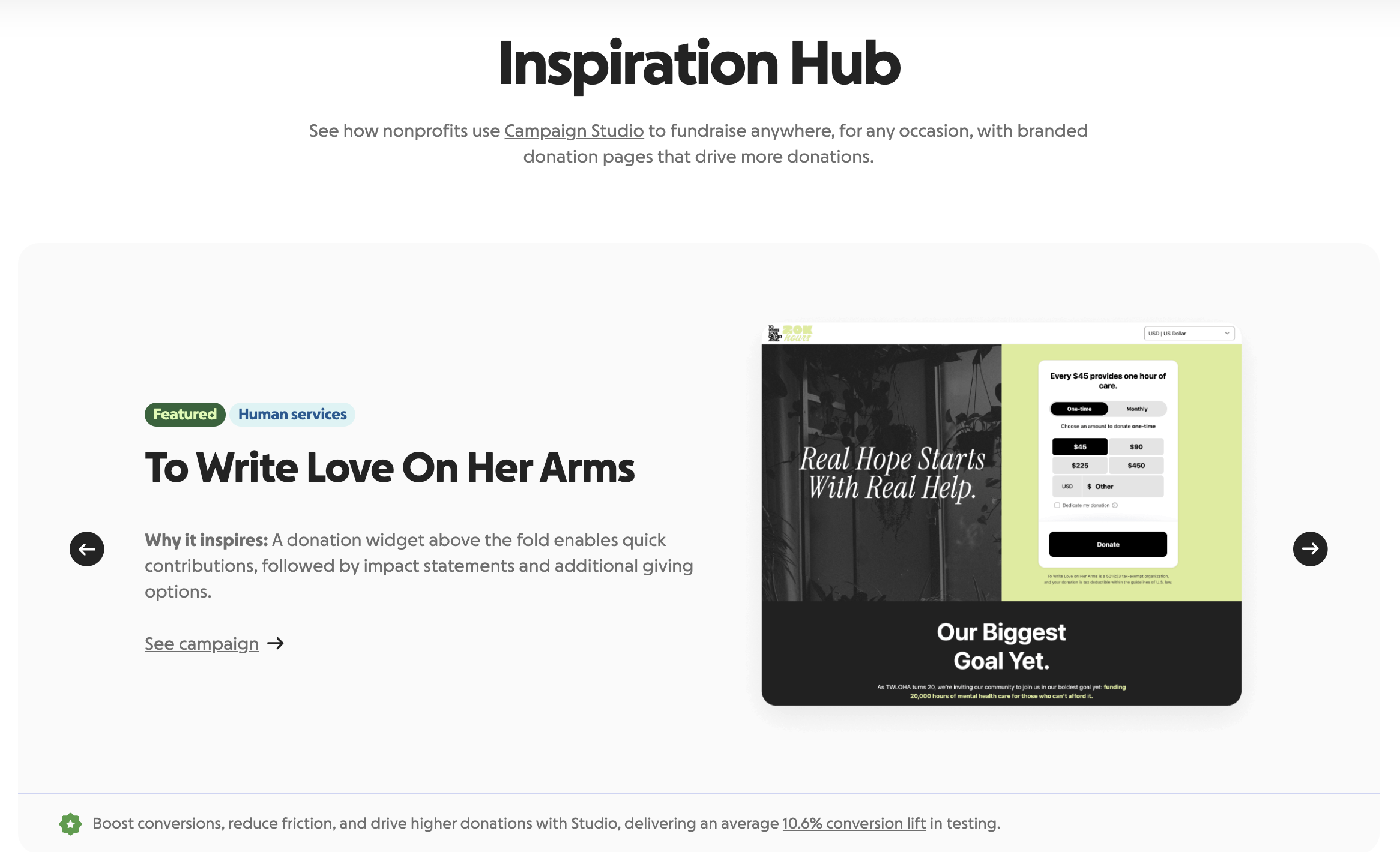
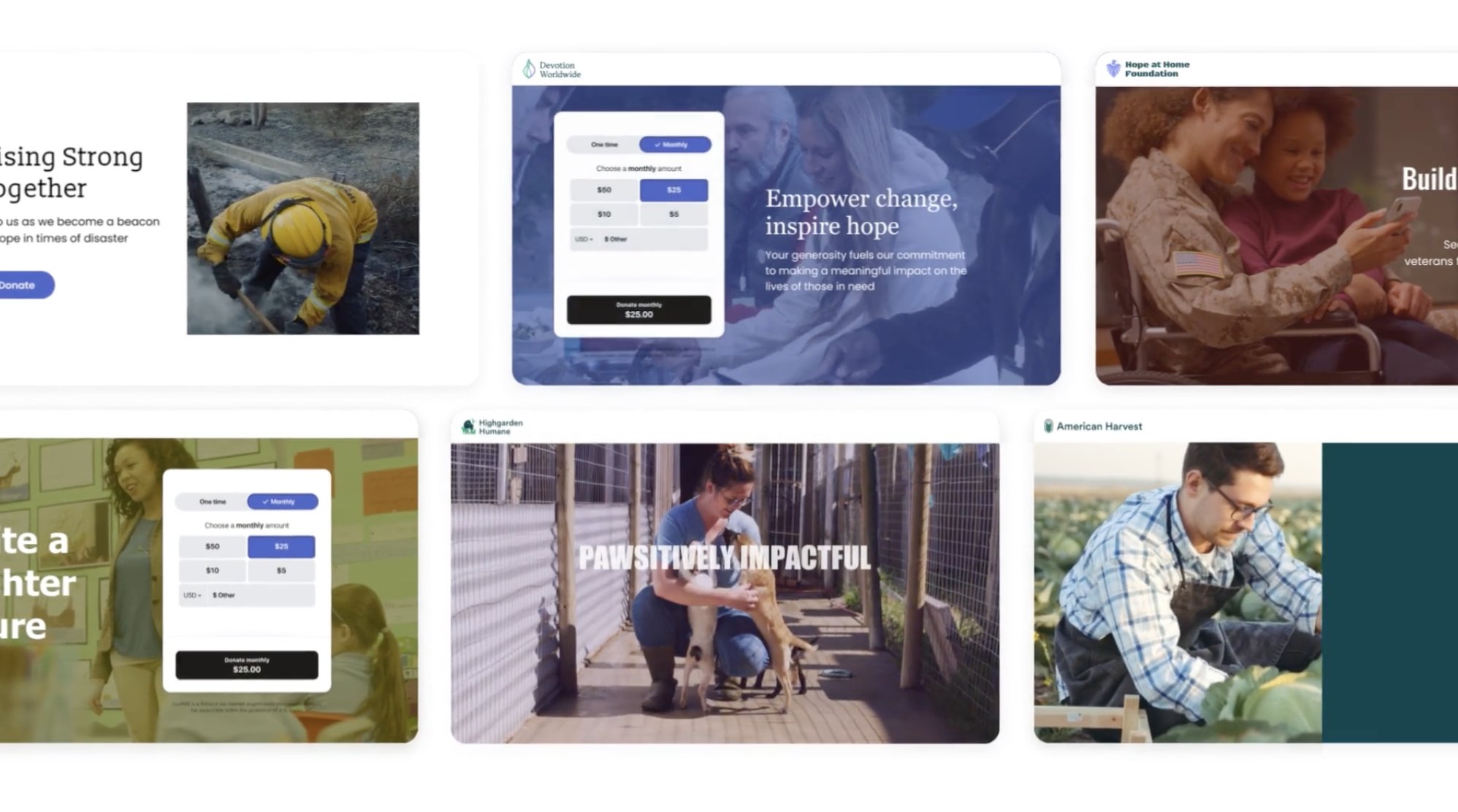
Our CX team turned the use case map and best practices into templates that customers could request, which later became productized templates. Then, the best customer examples on Studio were highlighted in the new Inspiration Hub.
This created a flywheel: more customers to built on Studio, expanded into new use cases, and turned adoption into more social proof to fuel our go-to-market motion.

A better builder alone wasn’t enough to change a campaign that already worked. Giving season became the compelling event that gave customers a reason to switch, especially once parity landed in October. Every customer already had a year-end campaign to build, so the question became why Studio, and how, for their specific campaign in this moment.
Our year-end campaign led with Studio and connected the most impactful giving-season strategies to our products. The year-end checklist I wrote positioned other top products as campaign-level add-ons, so we benefited from their halo while every entry point led back to Studio. Earlier in the year, we created compelling events and laid the groundwork at our annual conference, a dedicated event for 80 customers in Los Angeles, in launch webinars, and with live enterprise demos built around each account's top priority.

But asking enterprise teams to change their pages during their highest-volume weeks also takes trust. The matrix, beta proof, and performance data behind the first two answers helped earn it. For any launch, the lesson is the same: find the moment your customers already care about, and tie adoption to it.
Together, the stack connected product readiness to account action, and product capabilities to customer goals.
If I ran this launch today, I’d use AI to keep the matrix current across rolling releases, help sales and CS teams tailor the product story to each customer's needs, and analyze beta feedback and product behavior at scale.

Nobody gets excited to migrate.
New, better, and faster rarely change behavior across an entire customer base. In this example, getting to parity earned the trial. Translating it to specific use cases earned the adoption, and timing made it land.
Adoption happens in the translation layer: turning what a product does into when and why a customer should use it, and why they should start now.
That’s how a launch becomes momentum, momentum becomes adoption, and product marketing turns into measurable impact.
If you’re launching a product that replaces a familiar one, answer the core questions your customers will have before they ask.
Product Marketer in Technology & Software
Shannon set out to predict Klue’s product launch before its announcement and equip sales teams immediately. They used Crayon Sparks to analyze cross-channel signals, generate talk tracks, and distribute them through reps Read more
Principal Product Marketing Manager at Samsara
Cristina set out to make frequent product launches stick with Samsara’s sales force by replacing broad enablement with personalized field activation. Using Claude and Slack, they tailored outreach, sparked seller convers Read more
Comments
Founder at Dusted
This is a monstrous challenge you tackled! I especially love how you used customer feedback to shape your adoption strategy.
Product Marketing & GTM Leader in Technology & Software
Thank you Elle! My hope is more PMMs and marketers will see beta as a critical aspect of the messaging, positioning, and go-to-market strategy—and not just a vehicle for product to gather feedback.